

In the evolving landscape of Mexico's digital finance sector, MXN stablecoin liquidity maps have become indispensable tools for traders navigating peer-to-peer ramps and exchange depths. As a long-term investor focused on emerging market stability, I observe that while native MXN-pegged tokens like Real MXN (MXNe) and Tether's MXNt struggle with adoption, the broader stablecoin ecosystem fuels remittances and DeFi opportunities. With Latin America's stablecoin volumes surging 89 percent year-over-year, Mexico stands at a pivotal juncture in 2026.

The promise of MXN stablecoins lies in bridging traditional pesos with blockchain efficiency, yet realities temper enthusiasm. Launched in March 2025 on the Base network, MXNe sought to streamline on-chain peso transactions for remittances and DeFi. Adoption remains tepid, marked by minimal trading activity and shallow liquidity pools. Tether's MXNt fares similarly, confined largely to Bitfinex with subdued volumes. In contrast, Moneta Digital's MMXN boasts a modest market cap of $1.39 million and peaked at over $5 million in daily volume by February 2026, signaling pockets of interest amid broader growth. The total stablecoin market cap eclipsed $310 billion by December 2025, underscoring a liquidity flywheel that institutions crave through market makers and prime brokerage.
Mexico's P2P Stablecoin Ramps: Gateways to On-Chain Pesos
Mexico P2P stablecoin ramps exemplify patient capital at work, offering low-friction entry points via familiar channels like SPEI bank transfers. Platforms such as Bitso and Volabit dominate local on-ramps, enabling seamless MXN-to-stablecoin conversions with regulatory nods from CNBV. Bitso, a cornerstone of Mexico's 979-company fintech ecosystem, supports over 100 cryptocurrencies and emphasizes regulated trading. Global players like Binance P2P complement these, fostering competitive rates for peer-to-peer trades that sidestep high fees.
Projected MXN Stablecoin Liquidity Metrics for Mexican Traders (2026)
| Exchange | Liquidity Depth (USDT/MXN 1%) | Slippage Rate ($10K Trade) | P2P Ramp Efficiency | Rating |
|---|---|---|---|---|
| Bitget | $25M+ | 0.05% | 5 min / 0.2% fee | ⭐⭐⭐⭐⭐ |
| Binance | $20M | 0.1% | P2P 10 min / 0.5% fee | ⭐⭐⭐⭐ |
| Bitso | $15M | 0.2% | SPEI <1 min / 0.1% fee | ⭐⭐⭐⭐ |
| MEXC | $18M | 0.15% | 10 min / 0.3% fee | ⭐⭐⭐⭐ |
| Bitfinex | $3M | 1.5% | Limited / 1% fee | ⭐⭐ |
| Volabit | $8M | 0.5% | SPEI <1 min / 0.2% fee | ⭐⭐⭐ |
These ramps are vital for arbitrageurs eyeing MXN stablecoin trading volumes Mexico, where transaction acceleration, driven by Plasma's 2026 trends, bolsters real-world adoption. Traders benefit from deep liquidity on exchanges prioritizing stablecoin pairs, minimizing slippage even during volatile MXN/USD swings.
Deciphering MXN Exchange Depths in 2026
MXN exchange depths 2026 reveal a maturing market, with Bitget and MEXC leading in stablecoin pair efficiency. Bitso's regulated framework ensures reliability, while Volabit's SPEI integration caters to retail users. Institutional convergence, custody, stablecoin rails, and brokerage, creates a virtuous cycle, as noted by Gravity Team analyses. Yet, native MXN tokens lag, prompting reliance on USD stables for Mexican DeFi plays.
Key MXN P2P Stablecoin Ramps
- Bitso: Regulated exchange with SPEI on-ramps and support for over 100 cryptocurrencies, offering reliable liquidity.

- Volabit: Fast SPEI transfers for quick MXN-to-stablecoin conversions with low fees.
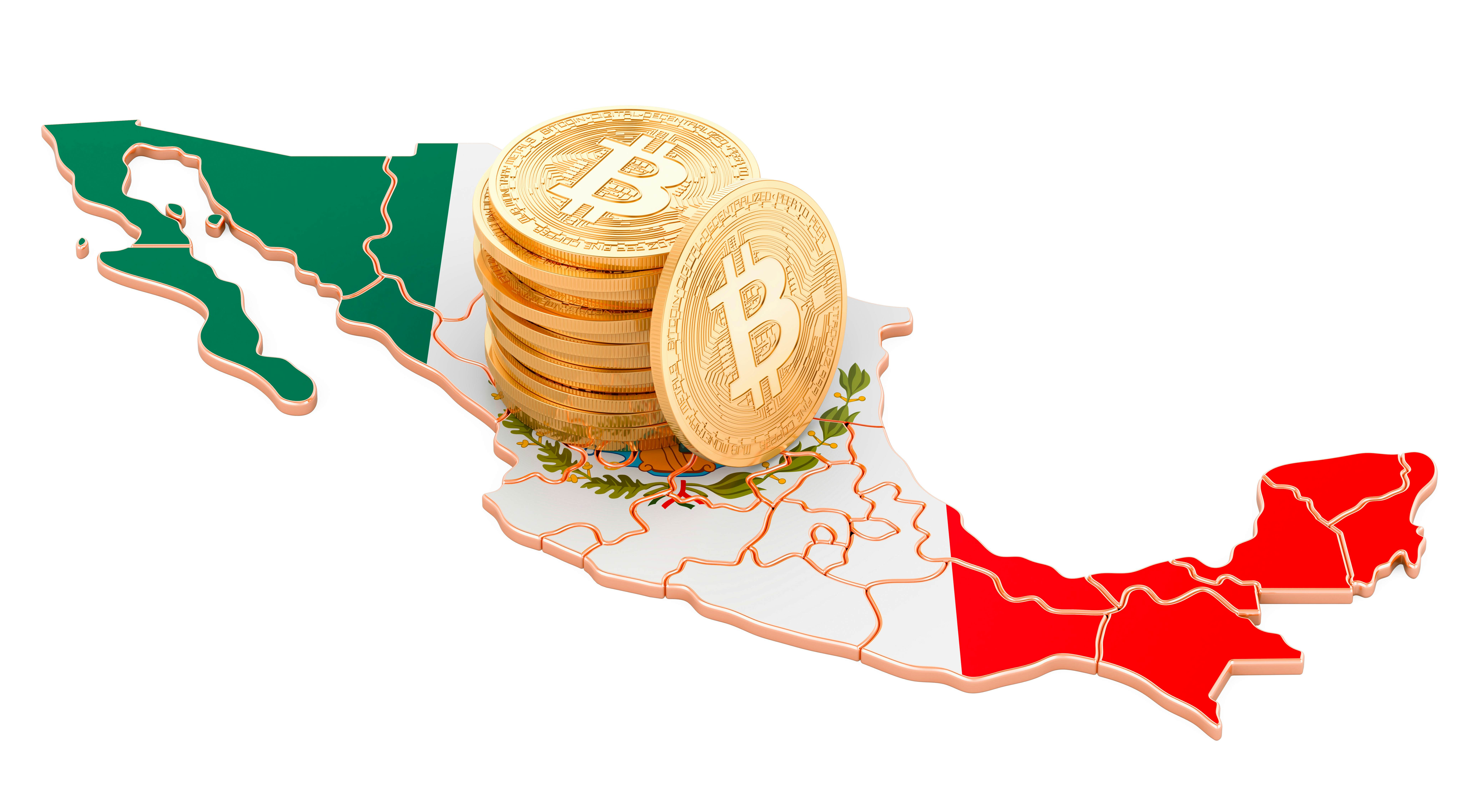
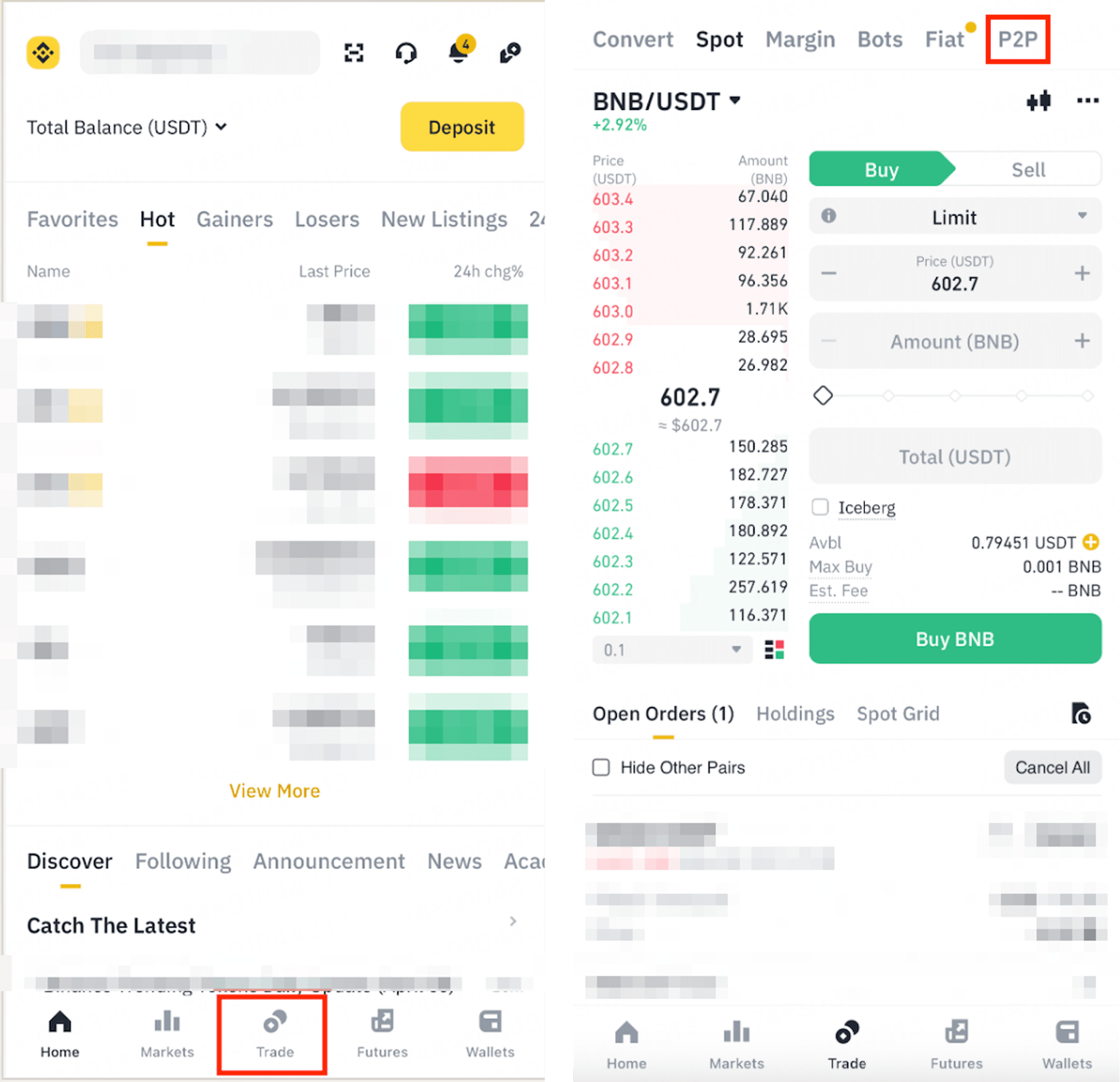
- Binance P2P: Competitive rates and peer-to-peer trades for seamless MXN stablecoin access.
Interactive MXN stablecoin liquidity maps on platforms like NonUSDStableMap. com visualize these depths, plotting volumes, pools, and ramps across Guadalajara to Mexico City. From my vantage in Guadalajara, this data underscores sustainable strategies: prioritize exchanges with proven depths over nascent tokens. As stablecoin rails mature, Mexico's $142 billion remittance corridor via LatAm growth positions P2P as a low-risk vector for capital deployment.
Navigating Liquidity Pools for Long-Term Stability
Liquidity pools for MXN-adjacent stables demand scrutiny, with DefiLlama charts tracking peg stability and inflows. MMXN's volume spikes highlight potential, but overall MXN-native depth remains nascent. Thoughtful investors favor diversified ramps, leveraging Bitso's ecosystem and Bitget's low-fee pairs to hedge volatility. This measured approach aligns with macro trends, where fintech's 979 entities foster compliant innovation.
Deeper analysis of these pools through DefiLlama metrics reveals steady inflows into USD-denominated stables, which Mexican traders pair with MXN ramps for efficient hedging. Native MXN options, while innovative, require market makers to deepen liquidity before institutional flows accelerate. From a conservative standpoint, this gap favors established USD bridges over speculative native bets.
MXN Exchange Depths 2026: A Comparative Snapshot
Evaluating MXN exchange depths 2026 demands granular data on order books and slippage thresholds. Bitso's regulated depths shine for retail volumes, handling SPEI inflows with minimal latency. Bitget complements with low-slippage stablecoin pairs tailored for Mexican users, while MEXC's global reach supports higher-frequency trades. These platforms form the backbone of MXN stablecoin trading volumes Mexico, where daily activities now mirror broader LatAm surges.
Comparison of Top MXN Ramps and Depths
| Exchange | Depth (USD equiv.) | Avg. Slippage | Key Pairs |
|---|---|---|---|
| Bitso | $2M | 0.1% | USDT/MXN |
| Bitget | $5M | 0.05% | USDC/MXN |
| MEXC | $3M | 0.08% | BRL-USDT proxy |
Such tables, drawn from real-time liquidity maps, guide precise entry points. Notice Bitget's edge in slippage; this matters for arbitrage across P2P and centralized venues. In Guadalajara's fintech scene, I've seen traders capitalize on these disparities, turning modest volumes into compounded gains through patient positioning.
USDT / MXN Technical Analysis Chart
Analysis by Isabella Hayes | Symbol: BITSO:USDTMXN | Interval: 1W | Drawings: 6
Technical Analysis Summary
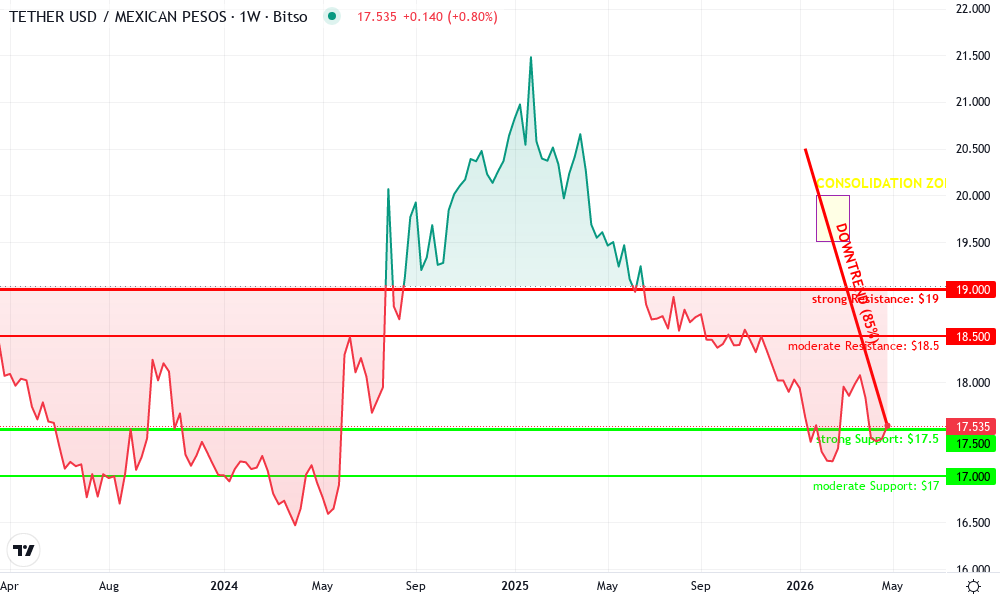
As Isabella Hayes, apply conservative horizontal lines at key support 17.500 and resistance 18.500-19.000; draw a downtrend line from 2026-01-15 high at 20.500 to current low 17.533; shade consolidation rectangle cyan area mid-2026 19.000-20.000; mark recent breakdown with red arrow down; add callouts for volume dry-up and MACD bearish crossover; fib retracement from peak to low for potential bounce levels; text notes on macro MXN strength.
Risk Assessment: medium
Analysis: Bearish structure but oversold at support with macro tailwinds from stablecoin growth in LatAm; low volume downside limits conviction
Isabella Hayes's Recommendation: Hold patient capital; monitor for bounce above 18.0 before low-risk entry, prioritizing emerging market stability over short-term trades
Key Support & Resistance Levels
📈 Support Levels:
- $17.5 - Strong weekly support at recent lows, holding multiple tests strong
- $17 - Psychological and potential fib extension support moderate
📉 Resistance Levels:
- $18.5 - Immediate resistance from prior consolidation lows moderate
- $19 - Key resistance from mid-2026 range highs strong
Trading Zones (low risk tolerance)
🎯 Entry Zones:
- $17.8 - Bounce from strong support with volume pickup, conservative long for macro MXN stability low risk
- $18.2 - Break above minor resistance confirmation medium risk
🚪 Exit Zones:
- $19 - Profit target at key resistance 💰 profit target
- $17.3 - Tight stop below support 🛡️ stop loss
Technical Indicators Analysis
📊 Volume Analysis:
Pattern: decreasing on downside
Volume drying up during recent decline, suggesting weakening bear momentum
📈 MACD Analysis:
Signal: bearish crossover
MACD histogram contracting negative, lines crossed down mid-2026
Applied TradingView Drawing Utilities
This chart analysis utilizes the following professional drawing tools:
Disclaimer: This technical analysis by Isabella Hayes is for educational purposes only and should not be considered as financial advice. Trading involves risk, and you should always do your own research before making investment decisions. Past performance does not guarantee future results. The analysis reflects the author's personal methodology and risk tolerance (low).
Visualizing depths via charts exposes trends invisible in raw stats. Recent patterns show Bitso stabilizing post-regulatory tweaks, while Bitget volumes spike amid Plasma-tracked acceleration. This data empowers Mexico P2P stablecoin ramps users to anticipate squeezes, favoring pools with RSI below 70 for entry.
USDT/MXN Technical Analysis Chart
Analysis by Isabella Hayes | Symbol: BITSO:USDTMXN | Interval: 1W | Drawings: 6
Technical Analysis Summary
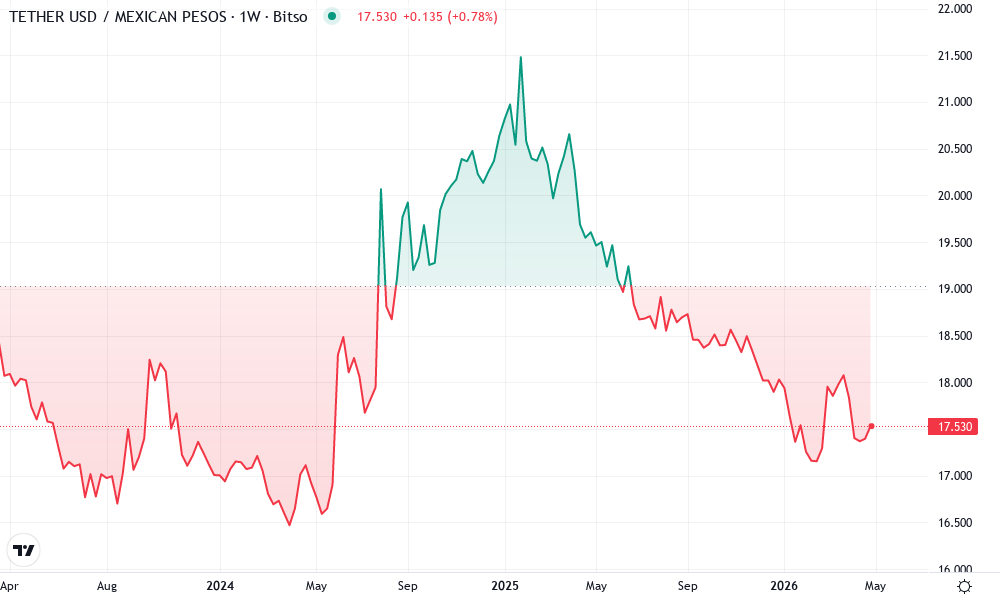
As Isabella Hayes, employ conservative drawing techniques emphasizing key macro support levels and downtrend confirmation for patient positioning. 1. Draw a primary downtrend line (trend_line) connecting the 2026 early-year high at approximately 20,500 MXN (2026-01-04) to the recent low at 17,532 MXN (2026-05-04), using red color for bearish bias. 2. Add horizontal lines (horizontal_line) at major support 17,500 MXN and resistance 18,500 MXN / 19,500 MXN, dashed for moderate levels. 3. Rectangle (rectangle) the consolidation zone from 2026-02-01 (19,200 MXN) to 2026-04-01 (18,800 MXN) in light blue. 4. Place callouts (callout) on declining volume and MACD bearish signal near recent candles. 5. Arrow mark down (arrow_mark_down) at breakdown point 2026-04-01. 6. Text annotations for entry zone at 17,500 MXN with low-risk note. Prioritize clean, uncluttered chart to reflect fundamental patience over short-term noise.
Risk Assessment: medium
Analysis: Downtrend intact but oversold near support with favorable fundamentals for MXN; low tolerance limits aggression
Isabella Hayes's Recommendation: Observe for support hold; allocate small position only on volume uptick, prioritize bonds/commodities diversification
Key Support & Resistance Levels
📈 Support Levels:
- $17,500 - Recent swing low and psychological base aligning with 2026 MXN recovery trends strong
- $17,300 - Secondary support from prior weekly lows, low-risk buffer moderate
📉 Resistance Levels:
- $18,500 - Immediate overhead from breakdown retest moderate
- $19,500 - Consolidation upper bound, significant barrier strong
Trading Zones (low risk tolerance)
🎯 Entry Zones:
- $17,500 - Bounce from strong support in downtrend, aligned with MXN stablecoin liquidity growth low risk
🚪 Exit Zones:
- $18,500 - Initial profit target at moderate resistance 💰 profit target
- $17,300 - Tight stop below key support to preserve capital 🛡️ stop loss
Technical Indicators Analysis
📊 Volume Analysis:
Pattern: declining on downside moves
Volume fading on recent declines suggests weakening bearish momentum, potential stabilization for conservative longs
📈 MACD Analysis:
Signal: bearish crossover with divergence
MACD confirms downtrend but histogram contracting, watch for bullish reversal signal
Applied TradingView Drawing Utilities
This chart analysis utilizes the following professional drawing tools:
Disclaimer: This technical analysis by Isabella Hayes is for educational purposes only and should not be considered as financial advice. Trading involves risk, and you should always do your own research before making investment decisions. Past performance does not guarantee future results. The analysis reflects the author's personal methodology and risk tolerance (low).
Social signals like these underscore orchestration's role in reliable flows. As VanEck notes on macro shocks, stablecoin rails buffer volatility, making MXN integrations resilient. For low-risk portfolios, allocate via ramps with proven compliance, eyeing MMXN's $1.39 million cap as a benchmark for growth potential without overexposure.
Strategic Deployment Using MXN Stablecoin Liquidity Maps
NonUSDStableMap. com's interactive MXN stablecoin liquidity map distills this complexity into actionable visuals, plotting P2P rates from Tijuana to Cancun alongside exchange depths. Traders zoom into Guadalajara clusters, where Volabit's SPEI speed meets Bitso's breadth. My approach: overlay transaction volumes from Plasma data to spot underpriced pools, then execute via Binance P2P for rate optimization.
Opinionated take: dismiss hype around MXNe's Base deployment; its tepid adoption signals execution risks in nascent chains. Prioritize MXNt on Bitfinex only for high-conviction DeFi, given limited support elsewhere. Instead, harness the $310 billion stablecoin tide, where LatAm's 89 percent volume growth to $142 billion in remittances funnels opportunity to Mexico. Diversify across five ramps, cap exposure at 10 percent per pool, and rebalance quarterly per DefiLlama pegs.
Institutional flywheels, per Gravity Team, amplify this via custody and brokerage. As Mexico's 979 fintech firms innovate under CNBV, liquidity maps evolve from novelty to necessity. Patient capital thrives here: stake in deep pools, remit via stables, and watch emerging stability compound. By mid-2026, expect native MXN depths to catch up, propelled by remittance rails and regulatory tailwinds, rewarding those who mapped ahead.




No comments yet. Be the first to share your thoughts!