
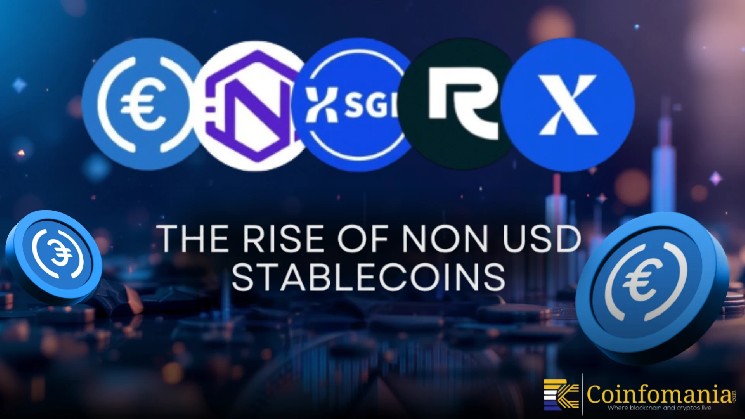
The $2B Non-USD Stablecoin Shift
The global stablecoin market is undergoing a quiet but measurable shift. While the US dollar remains the undisputed king of digital dollars, the non-USD stablecoin sector has reached a new milestone. According to research from ARKM, the circulating supply of non-USD stablecoins has surpassed $2 billion, marking a surge of over 42% in 2026 alone.
This growth signals an acceleration in demand for currency-pegged assets outside the dollar. For traders and institutions in Europe, Japan, and other regions, local stablecoins offer a direct hedge against currency volatility and a seamless bridge between fiat and crypto rails. However, the landscape remains nuanced. As Flagship Advisory Partners notes, non-USD stablecoins still account for only a marginal share of the total market, remaining niche and highly context-specific.
To understand the scale of this shift, it helps to look at the broader market dynamics. The dominance of USD-backed assets like USDT and USDC is rooted in their role as the primary medium for crypto trading and liquidity. Yet, the steady rise of EUR, JPY, and gold-backed tokens suggests that diversification is no longer just a theoretical preference—it is becoming a practical necessity for global participants.
EUR and JPY stablecoin liquidity
While USD-backed tokens dominate the broader market, capturing over 98% of stablecoin capitalization, a distinct ecosystem has formed around EUR and JPY pegs in EMEA and APAC. These non-USD stablecoins serve as critical bridges for local settlement rails, particularly in regions where traditional banking infrastructure is fragmented or inefficient. The liquidity dynamics here differ significantly from the USD-centric markets, driven more by regional regulatory compliance and specific trade corridors than by global speculative volume.
EUR stablecoins: Regulatory clarity and EMEA adoption
The Euro stablecoin market is largely defined by the European Union’s Markets in Crypto-Assets (MiCA) regulation, which provides a clear legal framework for issuers. This regulatory certainty has encouraged institutional participation, particularly in cross-border payments within the Eurozone. Major issuers like EURC (Circle) and EURe (Monerium) maintain deep liquidity pools on centralized exchanges and decentralized protocols, facilitating seamless fiat on-ramps for European traders. The primary use case remains settling invoices and managing treasury reserves for businesses operating within the EU, rather than retail speculation.
JPY stablecoins: APAC settlement and local rails
In Asia, JPY stablecoins such as JPYC (Jupiter Pay) and JPYX (Jupiter) cater to a market that traditionally relies on cash and domestic bank transfers. These tokens are gaining traction in APAC because they offer the speed of blockchain settlement while maintaining a 1:1 peg to the Japanese yen, avoiding currency fluctuation risks for local merchants. Liquidity is concentrated on regional exchanges and specific DeFi protocols that support Japanese fiat gateways. Unlike the USD-dominated global markets, JPY stablecoin volume is often tied to specific trade flows and remittance corridors rather than broad crypto trading pairs.
Market comparison: EUR vs. JPY
The table below compares the primary characteristics of leading EUR and JPY stablecoins, highlighting their backing assets and typical liquidity profiles. Note that trading volumes fluctuate daily based on regional market conditions and regulatory news.
| Token | Issuer | Backing Asset | Primary Region |
|---|---|---|---|
| EURC | Circle | Euro deposits | EMEA |
| EURe | Monerium | Euro deposits | EMEA |
| JPYC | Jupiter Pay | Japanese yen | APAC |
| JPYX | Jupiter | Japanese yen | APAC |
Gold-Backed and Commodity Maps
While fiat-collateralized tokens track central bank policy, commodity-backed stablecoins like Paxos Gold (PAXG) and Tether Gold (XAUT) offer a direct link to physical precious metals. These assets allow traders to hold tokenized gold without the logistical friction of storage, insurance, or physical delivery. They serve as a digital hedge against fiat inflation and currency volatility, preserving purchasing power when traditional currencies depreciate.
The mechanism is straightforward: one token represents one troy ounce of a specific gold bar, held in professional vaults. This structure merges the price stability of gold with the liquidity of blockchain. For investors seeking to diversify away from the US dollar, these tokens provide exposure to a hard asset that historically retains value during economic uncertainty.
To monitor the real-time performance of these assets, live market data is essential. Static prices quickly become outdated, making provider-backed widgets the only reliable way to track peg stability and price movements.
Gold-backed tokens are not just store-of-value instruments; they are also operational tools. They can be used in decentralized finance (DeFi) protocols to earn yield or serve as collateral for loans, effectively unlocking the value of illiquid physical assets. This utility distinguishes them from simply holding gold in a safe deposit box, offering a more flexible way to manage wealth in a digital-first economy.
Liquidity fragmentation risks
Non-USD stablecoins face a structural disadvantage that USD-denominated assets simply do not have: liquidity fragmentation. While the dollar stablecoin market operates with the depth and efficiency of a major fiat currency, non-USD options are scattered across smaller pools and niche exchanges. This fragmentation creates a higher risk of slippage and less favorable execution prices for traders.
In the USD stablecoin ecosystem, massive volume on centralized exchanges and deep liquidity on decentralized protocols allows for near-instant trades with minimal price impact. Non-USD stablecoins, such as EUR or JPY equivalents, lack this unified depth. Their liquidity is often split across fewer platforms, meaning large orders can significantly move the market against the trader.
This disparity means that while non-USD stablecoins offer utility for specific regional or sectoral needs, they require more careful management. Traders must account for wider spreads and potential liquidity gaps, especially during periods of market volatility. The lack of a unified, deep liquidity pool remains the primary hurdle for widespread adoption beyond their specific use cases.
| Feature | USD Stablecoins | Non-USD Stablecoins |
|---|---|---|
| Liquidity Depth | High (Deep pools) | Low (Fragmented pools) |
| Slippage Risk | Minimal | Moderate to High |
| Exchange Support | Universal | Limited/Niche |
Build a Non-USD Stable Map
Most stablecoin capital remains concentrated in US dollar assets, leaving a significant gap for regional exposure. With roughly 97% of fiat-backed stablecoins denominated in dollars, investors seeking direct currency hedging or local settlement rails must look beyond the standard USDT or USDC holdings. Building a non-USD stable map allows you to capture yield in local markets, hedge against dollar depreciation, and access emerging economies where USD liquidity is thin.
Start by identifying the specific currency risk you want to mitigate. If you operate in the Eurozone, EURC or EUROC provides a direct peg to the euro, reducing conversion friction for European merchants and traders. For exposure to Asian markets, consider the JPY-backed stablecoins emerging on high-throughput ledgers, which facilitate faster cross-border settlements in Japan. Gold-backed tokens like PAXG or XAUT offer a commodity hedge that moves independently of fiat monetary policy, serving as a store of value that is less correlated with central bank interest rate decisions.
Diversifying your stablecoin holdings requires active monitoring of regulatory developments in each jurisdiction. The European Union’s MiCA regulation, for instance, imposes strict reserve and redemption requirements on euro-pegged assets, offering a layer of protection not always present in offshore dollar stablecoins. By selecting tokens backed by regulated institutions in their respective regions, you align your portfolio with the most robust legal frameworks available.
Non-USD Stablecoin Types FAQ
Understanding the mechanics of non-USD stablecoins requires distinguishing between collateral types and peg mechanisms. This section clarifies common questions about classifications and specific assets like XRP.
Non-USD stablecoins are gaining traction as users seek alternatives to USD volatility in local markets. With circulating supply surging, understanding these distinctions is essential for accurate portfolio allocation and risk management.
No comments yet. Be the first to share your thoughts!