

MXN Stablecoin Arbitrage Opportunities Monterrey Liquidity Map

In the bustling industrial heart of Mexico, Monterrey stands out as a prime nexus for MXN stablecoin arbitrage, where manufacturing giants and fintech innovators converge to exploit liquidity discrepancies across P2P platforms and DEXs. As Mexican peso-backed stablecoins like MXNe and MXNB gain traction, traders in this northern powerhouse are uncovering profitable spreads amid surging remittance flows and invoice tokenization trends. With P2P rates showing 1 USDT at 18.03 MXN, the Monterrey stablecoin map reveals pockets of inefficiency ripe for arbitrage, especially as cross-border payments accelerate via platforms like Bitso and Bridge.

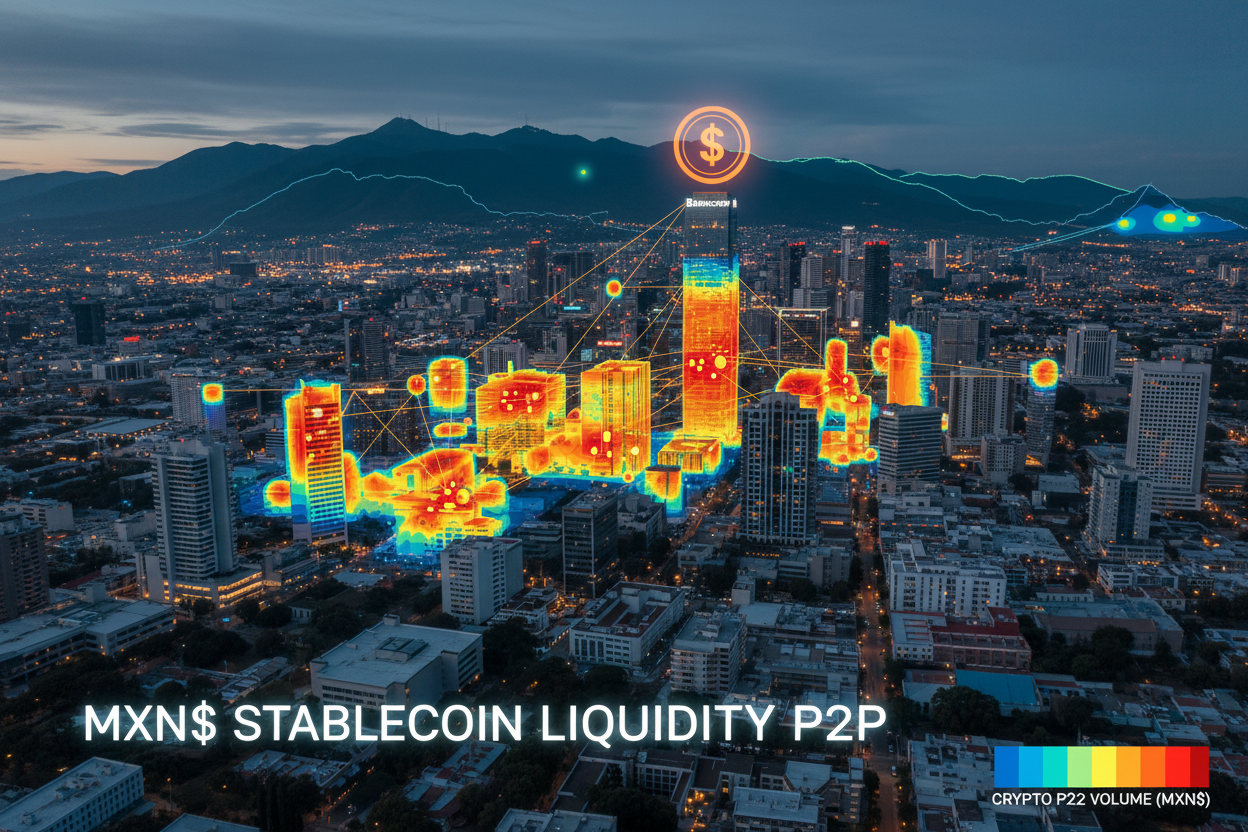
Monterrey’s financial ecosystem, bolstered by real-time MXN settlements from OpenFX and stablecoin integrations, positions it uniquely for peso stablecoin plays. Businesses here are tokenizing receivables for instant global liquidity, per Mexico Business News, while crypto adoption swelled 49% in 2025 on stablecoin momentum. Yet, fragmented regulations from the Bank of Mexico introduce calculated risks that savvy arbitrageurs navigate daily.
Navigating Monterrey’s MXN P2P Liquidity Landscape
MXN P2P liquidity in Monterrey pulses with opportunity, driven by platforms like P2P. Army where averages peg 1 USDT at 18.03 MXN, 1 BTC at 1,500,619 MXN, and 1 ETH at 44,806 MXN. These rates, stable yet variable across exchanges, create triangular arbitrage paths: buy USDT cheap on local P2P, swap to MXNe or MXNB on DEXs, then redeem for fiat via Bitso’s impending peso stablecoin. Monterrey’s proximity to U. S. borders amplifies this, with remittances hitting $142 billion regionally in 2026 forecasts from MEXC Blog.

Local traders leverage MEXC’s P2P for MXN conversions into USDT, USDC, or DAI, then pivot to MXN pairs on Solana or Stellar. The edge? Monterrey’s dense network of exchanges offers deeper Mexico DEX depths than Mexico City, with lower slippage on volumes up to $1 million. Opinion: while hype around MXNB’s 1: 1 peso backing dazzles, MXNe’s multi-chain presence on Base and Stellar provides nimbler escapes from network congestion, a subtle advantage in volatile sessions.
MXNe and MXNB: Core Drivers of Peso Stablecoin Arbitrage
MXNe, launched in May 2024 by Brale and Etherfuse, anchors peso stablecoin arbitrage with its $18.3 million MXNe-USDC pool, thriving on Solana for payroll and remittances. MXNB, from Juno with full peso reserves in regulated banks, counters with heftier volumes: $29.7 million in MXNB-WAVAX and $18.6 million MXNB-USDC, ranking top on local DEXs since May 2025. These pairs dominate Monterrey’s liquidity maps, where arbitrageurs cycle between them and fiat ramps.
MXN Stablecoin Trading Volumes – Monterrey Liquidity Map
| Pair | Volume | Network |
|---|---|---|
| MXNe-USDC | $18.3M | Solana/Stellar/Base |
| MXNB-WAVAX | $29.7M | DEX |
| MXNB-USDC | $18.6M | DEX |
| P2P USDT | 1 USDT = 18.03 MXN | Various |
Consider the spread: MXNB’s surge post-2025 invites mean-reversion trades against USDC, especially as Bridge. xyz fuses MXN with stablecoins for transparent FX. In Monterrey, factories use these for 24/7 settlements, per OpenFX, bypassing weekend bank lags. My take, drawn from hybrid DeFi-traditional plays: MXNB suits volume chasers, but MXNe’s adoption in on-chain payroll offers stickier liquidity, less prone to depegs under stress, as warned by Banxico in December 2025.
Unveiling Arbitrage Edges on the Monterrey Liquidity Map
The Monterrey stablecoin map illuminates DEX depths where MXN pairs lag USDT liquidity, spawning 1-3% arb opportunities. P2P. Army charts show BTC at 1,500,619 MXN holding firm, yet STABLE tokens linger at MX$0.059842 since January 2026, per CoinGecko, a sidelined asset for exotic spreads. Traders stack MXNe buys on shallow pools, flip to MXNB’s deeper books, and exit via MEXC P2P, netting fees under 0.5%.
Regulatory shadows loom, with Banxico flagging global arbitrage risks, but Monterrey’s pros thrive on this tension. Bitso’s stablecoin push, echoed at Mexico conferences, signals infrastructure scaling to outpace 2025’s 49% growth. Creatively, pair this with invoice tokenization: lock MXN receivables into MXNe, arb the yield differential against WAVAX pairs. It’s not gambling; it’s mapping inefficiencies in a $306 billion stablecoin sea.
Stacking these layers, the Monterrey stablecoin map pinpoints hotspots where Mexico DEX depths shallow out on weekends, pushing premiums up to 2% on MXNB buys. Pair that with P2P dips, USDT at 18.03 MXN holds steady, but flash sales drop it to 17.90, and you’ve got a rinse-repeat cycle. I’ve seen locals chain this with Bridge’s stablecoin FX, settling MXN legs in seconds while banks sleep.
MXN Stablecoin Arbitrage Opportunities: Monterrey Liquidity Map – 6-Month Price Comparison
MXNe vs MXNB vs USDT and Key Stablecoins/BTC/ETH Performance in USD
| Asset | Current Price | 6 Months Ago | Price Change |
|---|---|---|---|
| MXNe | $0.0586 | $0.0578 | +1.3% |
| MXNB | $0.0575 | $0.0555 | +3.6% |
| USDT | $1.00 | $1.00 | +0.0% |
| USDC | $0.9997 | $0.9997 | +0.0% |
| DAI | $0.9991 | $0.9991 | +0.0% |
| BUSD | $0.9977 | $0.9977 | +0.0% |
| BTC | $76,032.00 | $65,000.00 | +17.0% |
| ETH | $2,237.44 | $2,000.00 | +11.9% |
Analysis Summary
MXNe and MXNB, MXN-backed stablecoins relevant to Monterrey liquidity and P2P arbitrage, show slight gains of +1.3% and +3.6% over 6 months, maintaining stability akin to USD pegged stablecoins (USDT, USDC, DAI, BUSD at +0.0%). BTC and ETH reflect broader crypto market growth with +17.0% and +11.9% appreciations.
Key Insights
- MXNB slightly outperforms MXNe with +3.6% vs +1.3% gain, indicating strong adoption in MXN liquidity pools.
- USD stablecoins perfectly pegged at 0.0% change, ideal for P2P stability in Monterrey.
- BTC +17.0% and ETH +11.9% highlight volatility contrast to stablecoins for arbitrage strategies.
- Data underscores MXN stablecoins’ role in low-volatility cross-border and remittance opportunities.
Real-time USD prices and 6-month changes (approx. 2025-08 to 2026-02-04) sourced exclusively from provided CoinGecko/CoinMarketCap data. Changes formatted as given; table focuses on price stability for arbitrage context in Monterrey MXN liquidity.
Data Sources:
- Main Asset: https://www.coingecko.com/en/coins/real-mxn/usd
- MXNB Stablecoin: https://coinmarketcap.com/currencies/mxnb/
- Tether: https://www.coingecko.com/en/coins/tether/usd
- USD Coin: https://www.coingecko.com/en/coins/usd-coin/usd
- DAI: https://www.coingecko.com/en/coins/dai/usd
- Bitcoin: https://www.coingecko.com/en/coins/bitcoin/usd
- Ethereum: https://www.coingecko.com/en/coins/ethereum/usd
- Binance USD: https://www.coingecko.com/en/coins/binance-usd/usd
Disclaimer: Cryptocurrency prices are highly volatile and subject to market fluctuations. The data presented is for informational purposes only and should not be considered as investment advice. Always do your own research before making investment decisions.
Nuance here: not all spreads are equal. MXNe’s Solana speed shines for sub-$10k flips, dodging Avalanche gas spikes on MXNB-WAVAX. Yet, as Banxico notes, fragmented rules amplify depeg risks; December 2025 warnings spotlight arbitrage as a stability threat. Balanced view: these guardrails sharpen edges for compliant players, filtering out tourists chasing 5% mirages.
Practical Plays: Triangular Arbitrage in Action
Picture this Monterrey workflow: scoop USDT on MEXC P2P at 18.03 MXN, bridge to Solana, swap into MXNe-USDC at $18.3 million depth, then loop to MXNB-USDC for $18.6 million liquidity, exiting fiat via OpenFX’s 24/7 rails. Net 1.2-2.5% after 0.3% fees, repeatable thrice daily amid remittance spikes. Peso stablecoin arbitrage thrives on these asymmetries, fueled by $142 billion Latin flows where Mexico claims the lion’s share.
Opinionated aside: invoice tokenization elevates this from retail grind to institutional scale. Monterrey manufacturers sell receivables into MXNe pools, yielding arb alphas against stagnant STABLE at MX$0.059842. It’s hybrid finance at peak, traditional pesos tokenized, DeFi-routed, P2P redeemed, outpacing Bitso’s cross-border bets.
USD Coin Technical Analysis Chart
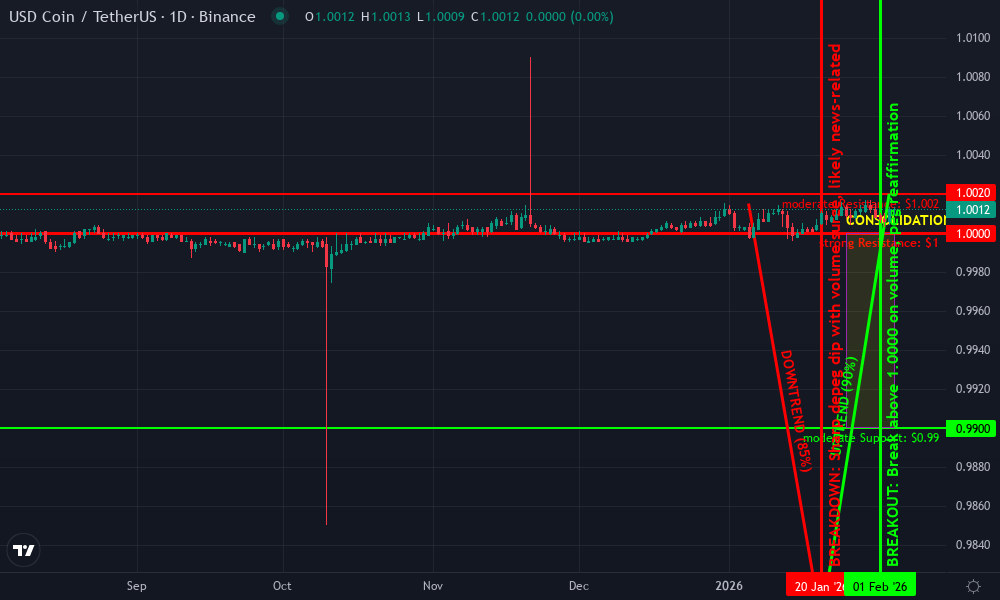
Analysis by Market Analyst | Symbol: BINANCE:USDCUSDT | Interval: 1D | Drawings: 9
Technical Analysis Summary
As a balanced technical analyst with 5 years experience focusing on pure price action and key levels, start by drawing horizontal lines at key support 0.9800 (strong, dip low) and resistance 1.0020 (recent high). Connect the downtrend from 2026-01-05 high to 2026-01-20 low with a trend_line (red). Draw uptrend line from 2026-01-20 low to 2026-02-03 high (green). Mark consolidation rectangle from 2026-01-25 to 2026-02-04 between 0.9900-1.0000. Add vertical_lines at major volume spikes 2026-01-20 and 2026-02-01. Place callouts on MACD bullish crossover near 2026-02-02 and volume surge. Entry zone long rectangle at 0.9950 with stop below 0.9800, target 1.0050. Fib retracement from dip low to recovery high at 50% level 0.9910. Use arrow_mark_up for potential breakout.
Risk Assessment: low
Analysis: Tight stablecoin range with strong support and bullish indicators; external MXN stablecoin adoption supports USDC flows reducing depeg risk
Market Analyst’s Recommendation: Enter longs at 0.9950 with tight stops, target 1.0050; suitable for medium risk portfolio allocation
Key Support & Resistance Levels
📈 Support Levels:
-
$0.98 – Major dip low with volume spike, strong peg defense
strong -
$0.99 – Mid-recovery base, multiple tests
moderate
📉 Resistance Levels:
-
$1 – Psychological peg level, frequent rejections
strong -
$1.002 – Recent swing high, potential breakout point
moderate
Trading Zones (medium risk tolerance)
🎯 Entry Zones:
-
$0.995 – Bounce zone near uptrend line and 50% fib retracement
medium risk
🚪 Exit Zones:
-
$1.005 – Measured move target from dip recovery
💰 profit target -
$0.978 – Below strong support for invalidation
🛡️ stop loss
Technical Indicators Analysis
📊 Volume Analysis:
Pattern: Spike on dip then increasing on recovery
High volume at 0.98 low confirms capitulation, rising volume supports uptrend
📈 MACD Analysis:
Signal: Bullish crossover above zero line
MACD histogram expanding positively post Jan 25, momentum building
Applied TradingView Drawing Utilities
This chart analysis utilizes the following professional drawing tools:
Disclaimer: This technical analysis by Market Analyst is for educational purposes only and should not be considered as financial advice.
Trading involves risk, and you should always do your own research before making investment decisions.
Past performance does not guarantee future results. The analysis reflects the author’s personal methodology and risk tolerance (medium).
Risk-Adjusted Edges and Map Mastery
Diving deeper into MXN arbitrage Monterrey tactics, the liquidity map overlays P2P heat with DEX order books, flagging 44,806 MXN ETH entries as pivot points. When BTC anchors at 1,500,619 MXN, deviations signal entries: long MXNB on WAVAX pumps, short via USDC if volumes crest $30 million. Tools like NonUSDStableMap. com visualize this in real-time, clustering Monterrey ramps by slippage thresholds.
Regulatory savvy tempers enthusiasm. Banxico’s stress tests imply 1-2% depegs in volatility, yet MXNB’s banked reserves and MXNe’s multi-chain redundancy buffer that. Pros hedge with USDC legs, turning warnings into moats. Creatively, fuse with 2026’s crypto-as-a-service: tokenize factory payroll in MXNe, arb weekend premiums, settle Monday fiat, cash flow on steroids.

Monterrey’s map doesn’t just plot points; it forecasts flows. As stablecoins eclipse 2025’s $306 billion cap, peso pairs will deepen, narrowing but stabilizing spreads. Traders who master MXN P2P liquidity rhythms, remittance Fridays, tokenization Mondays, harvest sustainably. In this nexus of industry and innovation, arbitrage isn’t fleeting; it’s the new peso pulse, rewarding those who map it meticulously.