
Non-USD stablecoin adoption 2026: market snapshot
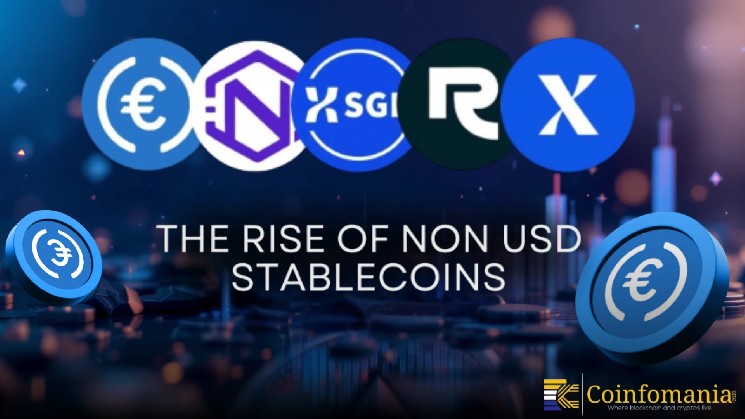
The global stablecoin market is expanding, but the growth story is no longer defined solely by the US dollar. While dollar-denominated assets still command roughly 99% of the $313 billion total supply, the non-USD segment is accelerating at a pace that signals a structural shift in 2026 Reap Global. This divergence is critical for understanding where liquidity is moving next.
The circulating supply of non-USD stablecoins has surged past $2 billion, marking a 42% increase in just the first part of 2026 ARKM Research. This rapid accumulation suggests that regional currencies are finding distinct utility in cross-border settlements and local hedging, rather than serving merely as secondary alternatives to USD pegs.
The most dramatic evidence of this trend is visible in the eurozone. EUR-denominated stablecoins experienced a 12-fold growth in monthly volume over a 15-month period, jumping from $69 million in January 2025 to $777 million by March 2026 TRM Labs. This specific acceleration highlights how non-USD stablecoin adoption 2026 is being driven by regional liquidity needs rather than global speculation.
The chart above illustrates the recent price action and volume for EURC against the USDT. While the peg remains stable, the volume spikes correlate with periods of heightened regional trading activity, confirming that these assets are being actively used for transfer and settlement rather than held passively.
EURC vs USDC performance metrics
The rapid expansion of non-USD stablecoin adoption 2026 is most visible in the Eurozone, where regional tokens are capturing local liquidity rather than serving as mere arbitrage vehicles. EURC (Euro Coin) and USDC (USD Coin) represent two distinct approaches to digital money: one rooted in regional utility and the other in global settlement dominance.
Recent data highlights this divergence. According to TRM Labs, EUR-denominated stablecoins experienced a 12-fold growth in transaction volume over 15 months, rising from $69 million per month in January 2025 to $777 million in March 2026. This surge suggests that businesses in the Eurozone are increasingly preferring local stablecoins for domestic payments, bypassing the friction of currency conversion.
| Metric | EURC (Euro Coin) | USDC (USD Coin) |
|---|---|---|
| Primary Use Case | Local Euro payments | Global settlement |
| Growth Trend | 12x volume growth | Stable dominance |
| Regulatory Focus | EU MiCA compliance | US/Global compliance |
| Market Cap | Regional scale | Global leader |
While USDC remains the benchmark for cross-border trade and DeFi liquidity, EURC is carving out a niche in European merchant acceptance and local remittances. This split indicates that the future of stablecoin adoption is not monolithic; it is fragmented by currency and regulation. As non-USD stablecoins gain traction, users are likely to choose the token that matches their immediate economic environment.
UK regulation for GBP stablecoins
The United Kingdom is moving to finalize the Payment Systems Regulator (PSR) framework, creating a clear path for GBP-pegged stablecoins to operate within domestic commerce. This regulatory clarity is a critical component of non-USD stablecoin adoption 2026, distinguishing the UK from jurisdictions where legal uncertainty still stifles innovation.
The PSR’s approach focuses on ensuring that stablecoins used for payments maintain the same resilience and efficiency as traditional bank transfers. By treating payment stablecoins as regulated payment services, the UK allows GBP-pegged tokens to settle instantly while adhering to strict reserve and liquidity requirements. This framework directly supports the integration of digital pounds into existing financial infrastructure, making them viable for everyday transactions.
As global markets look for alternatives to USD-centric systems, the UK’s proactive stance positions GBP stablecoins as a competitive option for cross-border and domestic trade. The finalization of these rules signals to financial institutions that GBP digital assets are a legitimate part of the payments landscape, accelerating their adoption across retail and corporate sectors.
JPY Stablecoin Integration
Japan is approaching non-USD stablecoin adoption 2026 with a focus on institutional stability rather than retail speculation. The country’s financial regulators and major banks are prioritizing the integration of JPY-backed stablecoins into existing payment rails, ensuring that these digital assets function as reliable tools for settlement rather than speculative instruments.
This strategy centers on leveraging the infrastructure of Japan’s largest financial institutions. Major banks are actively exploring how JPY stablecoins can streamline cross-border payments and domestic transactions. By anchoring these digital assets to the yen, they aim to provide a predictable, transparent rail for businesses that require speed and control in their financial operations. This approach mirrors broader global trends where stablecoins are evolving into usable, predictable rails for enterprise needs.
The integration process is cautious but deliberate. Regulators are working closely with banks to ensure compliance and security, fostering an environment where institutional adoption can grow without systemic risk. This methodical approach positions Japan as a key player in the non-USD stablecoin landscape, offering a model for how traditional finance can safely incorporate digital assets into everyday operations.
High-growth regions: Mexico, Brazil, and Nigeria
While Europe and Japan are refining their non-USD stablecoin adoption 2026 frameworks through regulatory clarity, emerging markets in Latin America and Africa are driven by immediate economic necessity. In these regions, stablecoins are not just an alternative investment; they are essential infrastructure for preserving value and enabling cross-border trade where local currencies face significant volatility.
Mexico and Brazil: The Peso and Real
In Mexico and Brazil, the USDT and USDC dominance is being challenged by local-pegged alternatives for specific settlement use cases. The Brazilian Real (BRL) and Mexican Peso (MXN) stablecoin ecosystems are growing rapidly, supported by local fintech integrations that allow merchants to accept stablecoins as a hedge against inflation. This adoption is less about speculation and more about practical liquidity management for businesses operating in high-inflation environments.
Nigeria and the Naira
Nigeria represents one of the highest-growth frontiers for non-USD stablecoin adoption 2026. Despite regulatory hurdles, the sheer volume of peer-to-peer (P2P) trading for the Naira (NGN) demonstrates a deep-seated demand for dollar-pegged stability. Platforms like Yellow Card report increasing transaction volumes as individuals and small businesses seek to bypass the limitations of the traditional banking system for remittances and savings. This grassroots adoption highlights a critical divergence: while Western markets focus on compliance, emerging markets prioritize accessibility and survival.

The contrast is stark. In the EU and UK, the narrative is about "compliant non-USD options" for institutional treasuries. In Mexico, Brazil, and Nigeria, it is about "accessible non-USD options" for everyday commerce. Both are essential to the global liquidity map, but they serve fundamentally different economic pressures.
FAQ: Non-USD stablecoin adoption 2026
Will stablecoins replace the US dollar?
Not immediately. While the total stablecoin market reached approximately $313 billion in mid-2026, roughly 99% of that volume remains dollar-denominated. The US dollar retains its dominance in global trade and reserve status, making a complete displacement unlikely in the near term. Instead, non-USD stablecoins are expanding as complementary tools for regional liquidity rather than direct replacements.
What is the most promising non-USD stablecoin?
EUR-backed tokens are currently showing the strongest growth trajectory. Data from early 2026 indicates that EUR-denominated stablecoins grew 12-fold over 15 months, rising from $69 million per month in January 2025 to $777 million by March 2026. This surge reflects a clear demand for euro-pegged assets within the European market, outpacing GBP and JPY alternatives.
Which country has the highest rate of crypto adoption?
Global adoption indices consistently highlight emerging markets as leaders in crypto usage. While specific rankings fluctuate quarterly, countries in Southeast Asia, Africa, and Latin America often top the charts due to high remittance volumes and currency volatility. In contrast, developed economies with stable fiat currencies tend to have lower transactional adoption rates, focusing more on investment than daily utility.
Does Trump have his own stablecoin?
No. Former President Donald Trump has not launched a personal stablecoin. While political figures have been involved in digital asset discussions and NFT projects, there is no official stablecoin issued under his name or brand. The stablecoin market is dominated by regulated issuers like Tether, Circle, and emerging regional players, not political personalities.
No comments yet. Be the first to share your thoughts!