What non-USD stablecoins actually are
Non-USD stablecoins are digital tokens pegged 1:1 to a national currency other than the US dollar. While USD-pegged assets like USDT or USDC dominate global trading volume, non-USD stablecoins serve a specific, high-value purpose: local currency settlement. They allow businesses and individuals to hold and transfer value in their local fiat—such as the euro (EUR), Brazilian real (BRL), or Mexican peso (MXN)—without converting to dollars first.
This distinction matters for enterprise payment teams. By using a local stablecoin, companies can bypass the friction and cost of cross-border FX conversions. For instance, a Brazilian importer paying a supplier in Mexico can settle directly in MXN stablecoins rather than routing funds through USD. This reduces settlement times from days to minutes and lowers transaction fees by eliminating multiple currency conversions.
The most prominent examples include EURC (issued by Circle for the euro) and various BRL-pegged tokens issued by regional providers. These assets operate on the same blockchain infrastructure as their USD counterparts but are governed by local regulatory frameworks. This localization makes them essential for global commerce, where maintaining liquidity in local currency is often more efficient than relying on the dollar as an intermediary.
Leading non-USD stablecoin options
The non-USD stablecoin market has shifted from niche experiments to a functional layer for global commerce. As local currencies move on-chain, the primary contenders are now defined by their peg stability, regulatory backing, and regional liquidity. While the US dollar remains the dominant global reserve asset, tokens pegged to the euro, Singapore dollar, and other major economies are capturing significant market share for cross-border settlements.
The growth trajectory is evident. According to recent industry data, non-dollar stablecoins have seen a thirtyfold increase in holders since 2023, driven by regulatory clarity and local demand for faster, cheaper remittances. This section outlines the most prominent options available for enterprise and consumer use in 2026.
Euro-backed options: EURC
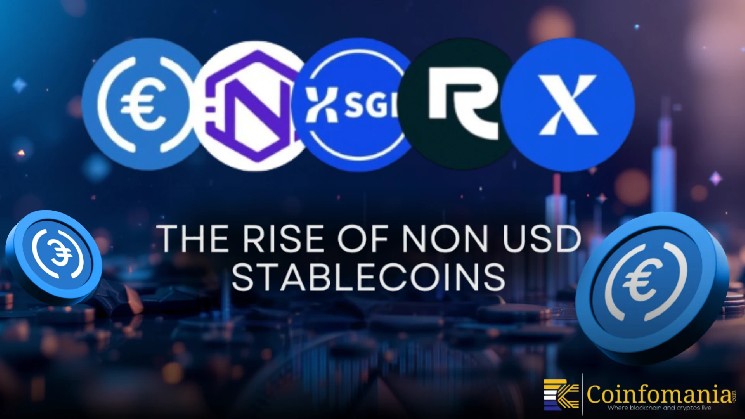
EURC, issued by Circle, is currently the most established non-USD stablecoin. Pegged 1:1 to the euro, it benefits from Circle’s existing infrastructure and regulatory compliance in the European Economic Area. It is widely used for B2B payments between European entities and for settling trade finance transactions where USD conversion costs are prohibitive. Its primary advantage is deep integration with existing financial rails and a transparent reserve structure.
Asian regional tokens
In Asia, the Singapore dollar (SGD) and Japanese yen (JPY) stablecoins are gaining traction. Tokens like the Digital Yen or various SGD-pegged assets are often issued by regulated fintech firms or banks operating within specific jurisdictions. These tokens are particularly useful for intra-Asian supply chain payments, allowing businesses to avoid the volatility and friction of converting between local Asian currencies and USD. Liquidity is currently concentrated on high-throughput blockchains like Polygon and Solana.
Emerging Latin American and other pegs
Tokens pegged to the Brazilian real (BRL) and Mexican peso (MXN) are emerging as critical tools for regional trade. Given the high inflation rates and currency volatility in these markets, local stablecoins provide a digital hedge and a faster settlement mechanism for cross-border e-commerce. While smaller in market cap compared to EURC, these tokens are seeing rapid adoption among local merchants and remittance providers who prioritize speed over the liquidity depth of major global currencies.
Comparison of top non-USD stablecoins
The table below compares the key attributes of the leading non-USD stablecoins, highlighting their issuer, pegged currency, and primary use case.
| Token | Issuer | Pegged Currency | Primary Use Case |
|---|---|---|---|
| EURC | Circle | Euro (EUR) | European B2B payments |
| Digital Yen | Various Regulated Fintechs | Japanese Yen (JPY) | Intra-Asia trade settlement |
| SGD-pegged Tokens | Singapore-based Entities | Singapore Dollar (SGD) | Regional fintech integrations |
| BRL/MXN Stablecoins | Local Latin American Firms | Real / Peso | Remittances & inflation hedge |
Market context and liquidity
Understanding the market dynamics is essential for choosing the right token. While EURC offers the deepest liquidity, emerging tokens like those pegged to Latin American currencies are growing faster in terms of user acquisition. Investors and businesses should monitor the total market cap of non-USD stablecoins, which has recently surpassed $1.2 billion, indicating a strong shift toward multi-currency digital assets.
Related tools and hardware
For users managing a diverse portfolio of stablecoins across different blockchains, secure storage and easy conversion are paramount. The following products can help streamline your stablecoin management.



As an Amazon Associate, we may earn from qualifying purchases.
When local currency stables make sense
Non-USD stablecoins offer a competitive advantage when the cost of converting to or from the US dollar outweighs the benefits of dollar pegging. While USD stablecoins dominate global liquidity, local currency tokens solve specific friction points in emerging markets and regional trade corridors.
The growth trajectory supports this shift. According to market data, the supply of non-USD stablecoins grew 3x (+300%) over the same period that USD stablecoins grew 2.3x (+130%) [src-serp-2]. This acceleration is driven by local demand for inflation hedging and reduced FX conversion costs [src-serp-7].
Hedging against local inflation
In countries experiencing high inflation or currency devaluation, holding a local stablecoin can be more practical than holding USD for everyday transactions. Users avoid the double-spread penalty of converting local fiat to USD and then back to local fiat for purchases. This is particularly relevant in economies where USD is scarce or expensive to access.
Reducing FX conversion costs
For cross-border trade within a region, such as the Eurozone or Southeast Asia, local stablecoins eliminate the need to route payments through USD. This reduces settlement times and fees. For example, a business in Brazil paying a supplier in Argentina can use local stablecoins to bypass the volatility and cost of USD intermediary transactions.
Regulatory and liquidity considerations
Local stablecoins are often subject to stricter regulatory oversight, which can provide greater transparency and consumer protection. However, liquidity may be lower than USD stablecoins, leading to wider spreads during high volatility. Users should assess the issuer's reserves and regulatory compliance before adopting local stablecoins for significant transactions.
Liquidity and adoption choices that change the plan
The primary risk of using non-USD stablecoins is lower liquidity and narrower adoption. While USD stablecoins like USDT and USDC dominate global crypto trading and remittance corridors, non-USD alternatives remain niche and highly context-specific.
Liquidity gravity is a significant barrier. The global financial market is already built on USD infrastructure. Non-USD stablecoins, such as EUR-pegged or local currency tokens, struggle to attract deep order books because most trading pairs and institutional liquidity are denominated in dollars. This means that larger trades can suffer from higher slippage, and exit liquidity may be thinner during market stress.
Adoption is similarly constrained. Most exchanges, merchants, and payment processors prioritize USD assets for their stability and ease of conversion. Using a non-USD stablecoin often requires an extra conversion step back to USD or a local fiat currency, adding friction and potential cost. As one analysis notes, unless a non-USD stablecoin solves the liquidity gravity problem, it will likely fail to gain traction beyond its immediate local ecosystem. For global cross-border payments, the USD network effects remain too strong to ignore.
Choosing the right stablecoin for your needs
Selecting a non-USD stablecoin requires matching the currency peg to your actual cash flow needs. If your business operates primarily within the eurozone, holding EURC (issued by Circle) eliminates the foreign exchange friction of converting from USD. Similarly, companies in emerging markets may prioritize local currency tokens to avoid the volatility of the US dollar against their domestic currency.
Before adopting any non-USD stablecoin, verify three critical factors:
- Regulatory Status: Ensure the issuer is registered and compliant in your jurisdiction. Non-USD tokens often face stricter local banking regulations than their USD counterparts.
- Liquidity Depth: Check if there is sufficient trading volume on decentralized exchanges (DEXs) or centralized platforms (CEXs) to execute your transaction size without significant slippage.
- Issuer Transparency: Confirm that the issuer publishes regular, audited attestation reports proving the reserve assets back the token 1:1.
The decision ultimately hinges on your settlement requirements. If you need global reach and deepest liquidity, USD stablecoins remain the default. However, for regional trade and treasury management, a local currency stablecoin can reduce costs and simplify accounting.
Frequently asked questions about non-USD stablecoins
Non-USD stablecoins are digital tokens pegged 1:1 to a national currency other than the US dollar. Examples include EURC (euro, issued by Circle) and BRLP (Brazilian real). As of 2026, the market for these local-currency tokens has grown 30x in holders since 2023, reaching $1.2 billion in total value, driven by local demand and evolving regulation.
Are non-USD stablecoins safe to hold?
Safety depends on the issuer and the underlying reserves. Major stablecoins like EURC are issued by regulated entities that hold reserves in cash and short-term government bonds. However, non-USD stablecoins carry currency risk and regulatory uncertainty that USD-pegged tokens do not. Always verify the issuer’s reserve reports and regulatory status before holding significant amounts.
How are non-USD stablecoins regulated?
Regulation varies by jurisdiction. In the EU, stablecoins fall under MiCA (Markets in Crypto-Assets), which requires strict reserve management and transparency. In other regions, local central banks or financial authorities may impose additional rules. For example, Circle operates EURC under EU regulations, while other local stablecoins may be subject to different legal frameworks. Always check local laws before trading.
Where can I buy non-USD stablecoins?
Non-USD stablecoins are available on select centralized exchanges (CEXs) and decentralized exchanges (DEXs) that support the specific currency pair. For instance, EURC can be traded on exchanges that list Euro-denominated assets. Availability depends on your location and the exchange’s compliance with local regulations. Use official exchange listings and verify trading pairs before purchasing.
Why use non-USD stablecoins instead of USD?
Non-USD stablecoins reduce currency conversion costs and exposure for businesses and individuals in non-US economies. They enable faster, cheaper cross-border payments in local currencies, avoiding the need to convert to USD and back. This is particularly useful for enterprise payment teams settling invoices in EUR, BRL, or SGD, as noted by industry guides on local-currency settlement.
No comments yet. Be the first to share your thoughts!