Non-USD stablecoins 2026 market snapshot
The non-USD stablecoin sector reached a notable milestone in 2026, with circulating supply hitting $2 billion. This figure represents a surge of over 42% from the start of the year, signaling a clear acceleration in adoption outside the dominant US dollar ecosystem. While still a fraction of the total stablecoin market, this growth marks a shift from niche experimentation to tangible market presence.
Historical context highlights the scale of this recent expansion. According to data from Artemis, non-USD stablecoin supply stood at just $261 million in May 2021. By April 2026, that figure had climbed to approximately $771 million before continuing its upward trajectory to the current $2 billion level. This rapid growth suggests that regional currencies are finding more robust use cases for cross-border payments and local liquidity management.
The market is currently defined by a few key regional players rather than a broad dispersion of tokens. EURC, pegged to the Euro, and BRZ, the Brazilian Real stablecoin, have emerged as dominant forces. These tokens cater to specific geographic needs, offering alternatives to the US dollar for residents in the Eurozone and Brazil who seek to hedge against local currency volatility or facilitate cheaper international transfers.
Despite this progress, non-USD stablecoins still struggle to crack 0.5% of the total stablecoin market share. The US dollar remains the overwhelming standard, with tokens like USDT and USDC commanding the vast majority of circulating supply. However, the $2 billion threshold demonstrates that there is a sustained, growing demand for non-dollar digital assets, particularly in regions with strong local economic activity and regulatory clarity.
Leading non-USD stablecoins compared
The non-USD stablecoin sector reached a record $2 billion in circulating supply in 2026, driven by a 43% annual increase. While USDC remains the global standard for dollar-pegged assets, EURC, BRZ, and A7A5 are capturing specific regional and utility-driven markets. These assets diverge from the USD standard by pegging to local currencies or basket assets, offering distinct reserve compositions and liquidity profiles.
Understanding the differences between these non-USD stablecoins requires looking beyond price stability. The primary differentiators are the underlying reserve assets—whether they hold cash, short-term government bonds, or a basket of currencies—and the regulatory jurisdictions governing their issuance. Liquidity also varies significantly, with EURC benefiting from broader European integration and BRZ leveraging strong ties to Latin American payment rails.
The table below compares the three dominant non-USD stablecoins against the USDC baseline. This comparison highlights how reserve composition and chain availability impact their utility for cross-border transactions and regional settlements.
| Asset | Peg | Primary Reserves | Jurisdiction | Top Chains |
|---|---|---|---|---|
| USDC | USD | Cash & Short-Term US Treasuries | United States | Ethereum, Solana, Tron |
| EURC | EUR | Cash & Short-Term Euro Bonds | European Union | Ethereum, Polygon, Arbitrum |
| BRZ | BRL | Cash & Brazilian Government Bonds | Brazil | Ethereum, BNB Chain, Polygon |
| A7A5 | Basket (USD/EUR/JPY) | Diversified Short-Term Bonds | Multi-jurisdictional | Ethereum, Optimism |
Reserve composition and regulatory risk
Reserve composition is the most critical factor for non-USD stablecoins. Unlike USD-backed assets that rely on the US Treasury market, EURC and BRZ hold local sovereign debt. This introduces currency-specific interest rate risks and regulatory dependencies. For example, BRZ is subject to Brazilian Central Bank regulations, which may change how liquidity is managed during local economic volatility. A7A5, utilizing a basket peg, attempts to mitigate single-currency risk but introduces complexity in maintaining the peg during divergent monetary policies among its constituent currencies.
Regulatory jurisdiction also dictates accessibility. USDC and EURC operate under well-defined regulatory frameworks in the US and EU, respectively, providing transparency that institutional users prefer. BRZ, while compliant with local laws, may face friction when used outside Latin America due to AML/KYC requirements specific to Brazilian financial institutions. Investors and users should verify that the stablecoin issuer provides regular, audited reserve attestations to ensure the backing assets remain liquid and secure.
Liquidity and cross-chain availability
Liquidity varies significantly across the non-USD stablecoin ecosystem. EURC benefits from its alignment with the Eurozone's financial infrastructure, making it a preferred choice for European DeFi protocols and cross-border B2B payments. BRZ has established strong liquidity on chains popular in Latin America, such as BNB Chain and Polygon, facilitating remittances and local commerce. A7A5, while less dominant in volume, offers niche utility for users seeking exposure to a multi-currency basket without holding multiple individual stablecoins.
When comparing these assets to USDC, it is important to note that USDC generally offers deeper liquidity pools and wider exchange support globally. However, for users operating within specific regional economies, the local stablecoin often provides lower friction and better integration with local banking rails. The choice between a global USD stablecoin and a regional non-USD alternative should be driven by the specific transaction context and regulatory environment.
Regional drivers and adoption channels
The growth of non-USD stablecoins is not a uniform global shift but a series of localized responses to regulatory pressure and payment infrastructure gaps. While the US dollar dominates global trade, specific regions are turning to local currency stablecoins to bypass restrictions or leverage existing digital rails.
Europe: Regulatory Pushback Against USDT
European adoption is driven largely by regulatory divergence. The European Union’s Markets in Crypto-Assets (MiCA) regulation imposes strict reserve and transparency requirements that many major USDT issuers have struggled to meet fully. This has created a vacuum for regulated local alternatives.
Investors and merchants in the Eurozone are increasingly favoring EURC and other MiCA-compliant tokens over USDT for domestic transactions. This shift is less about ideological preference and more about compliance safety. By holding a stablecoin issued by a regulated European entity, users avoid the legal ambiguity of holding a US-issued asset in a jurisdiction with tightening oversight.
Latin America: Pix and Remittance Rails
In Latin America, adoption is fueled by utility rather than regulation. Brazil’s Pix instant payment system has set a high bar for domestic transaction speed and cost. Local stablecoins like BRZ (Brazilian Real) are being integrated directly into these rails, allowing users to move value on-chain and off-chain with near-zero friction.
Beyond Brazil, LATAM remittances are a major driver. Sending money across borders in the region often involves high fees and slow settlement times. Non-USD stablecoins offer a faster, cheaper alternative for diaspora communities, particularly in Argentina and Colombia, where local currency volatility makes holding USD assets risky or illegal. These tokens act as a bridge between traditional banking and crypto, leveraging local fiat pegs for stability.
Asia: Local Currency Stability
In APAC, non-USD stablecoins serve as hedges against local currency depreciation. Countries with volatile fiat currencies, such as Vietnam and the Philippines, see higher adoption of locally pegged tokens. These assets allow users to maintain purchasing power without relying on the US dollar, which may not be easily accessible or desirable for everyday commerce.
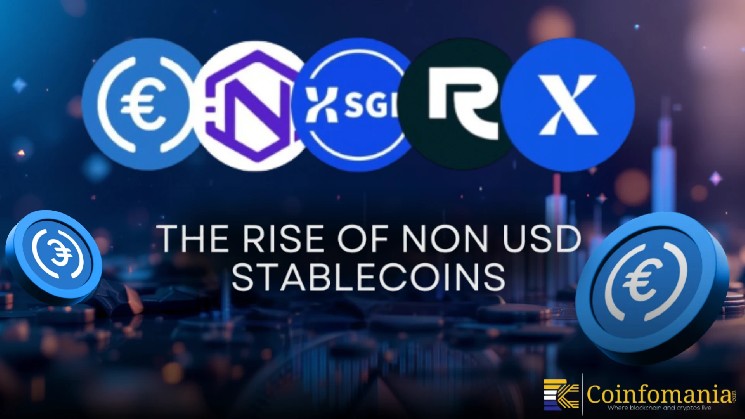
The growth of non-USD stablecoins to $2 billion in 2026 highlights this regional specificity. EURC, BRZ, and other local tokens are emerging as dominant players in their respective markets, driven by the need for localized, compliant, and efficient digital money.
Liquidity risks and yield choices that change the plan
Non-USD stablecoins like EURC and BRZ face a distinct structural disadvantage: thin liquidity. While their total supply has grown, reaching $2 billion in 2026, their trading volume remains a fraction of USD-based giants. This disparity creates high slippage, meaning large trades can significantly move the price away from the peg, turning a supposedly stable asset into a volatile one during periods of market stress.
The tradeoff for holding these assets often involves higher yields, but this comes with elevated counterparty risk. Unlike USD stablecoins backed by US Treasuries, non-USD alternatives may rely on local commercial paper or complex reserve structures that are harder to audit in real-time. When liquidity dries up, the yield premium vanishes, leaving holders exposed to both depegging and insolvency risks.
Non-USD stablecoin FAQs
How does EURC compare to USDC in terms of reserves?
EURC holds cash and short-term Euro bonds, regulated under EU MiCA standards. USDC holds cash and short-term US Treasuries, regulated under US standards. EURC is better suited for Eurozone transactions, while USDC offers broader global liquidity.
Why is BRZ popular in Latin America?
BRZ is integrated with Brazil’s Pix instant payment system, allowing near-zero friction for domestic transactions. It also facilitates cheaper and faster cross-border remittances for diaspora communities in countries like Argentina and Colombia.
What are the risks of holding non-USD stablecoins?
The primary risks include lower liquidity leading to higher slippage, currency-specific interest rate risks due to local sovereign debt reserves, and regulatory friction when moving assets across borders. Counterparty risk is also higher as audits may be less frequent or transparent than for major USD stablecoins.
No comments yet. Be the first to share your thoughts!