
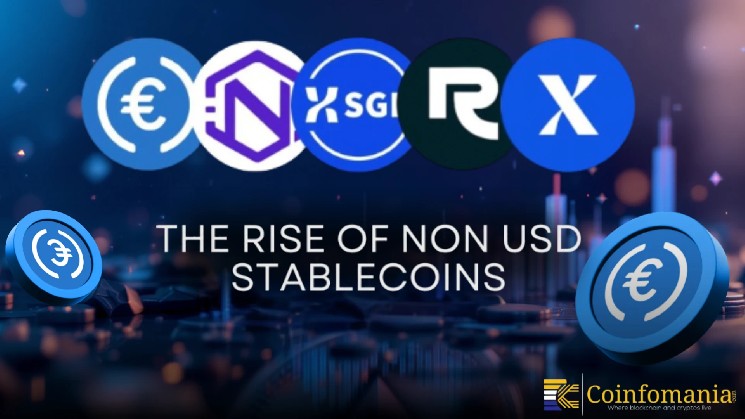
What are non-USD stablecoins in 2026?
Non-USD stablecoins are digital assets pegged to fiat currencies other than the US dollar, such as the Euro (EUR), British Pound (GBP), or Brazilian Real (BRL). While the market has long been dominated by dollar-pegged giants like USDT and USDC, these regional alternatives are gaining traction as on-chain financial infrastructure matures. They serve as a bridge between traditional fiat systems and blockchain networks, allowing users to transact in their local currency without the friction of immediate conversion to dollars.
The growth in this sector has been steady but niche. From January 2023 to February 2026, the total supply of local currency stablecoins grew from approximately $700 million to nearly $1.2 billion. This expansion reflects a shift toward regional utility, particularly in markets where regulatory frameworks like MiCA in Europe provide clear pathways for issuance, or where local users seek direct access to crypto markets without dollar intermediation.
These assets are not merely speculative; they function as essential tools for cross-border payments and local settlement. For instance, EURC provides Euro-denominated stability for European DeFi applications, while BRL-based tokens facilitate faster, cheaper remittances within Brazil. Despite their utility, non-USD stablecoins remain a small fraction of the overall stablecoin market, often struggling to capture more than 0.5% of total market share. Their success is highly context-specific, relying on strong local regulation, banking partnerships, and genuine demand for local currency liquidity on-chain.
EURC vs USDC: The European Divergence
European stablecoin adoption in 2026 is defined by a single regulatory threshold: compliance with the Markets in Crypto-Assets (MiCA) framework. This legislation created a sharp divergence between European-issued EURC and the global standard, USDC. For merchants and users in the EU, the choice is no longer just about which coin is cheaper to move, but which one is legally permitted to operate without friction.
USDC remains the dominant global stablecoin by volume, offering deep liquidity across most decentralized finance (DeFi) protocols. However, its US-based issuance structure creates compliance risks for European entities under MiCA. EURC, by contrast, is built specifically for the European market, ensuring full regulatory alignment. This compliance comes with a trade-off: EURC often trades at a slight premium due to lower liquidity compared to its American counterpart.
The following comparison breaks down the structural differences that determine which stablecoin fits your operational needs.
| Feature | EURC | USDC |
|---|---|---|
| Regulatory Status | MiCA Compliant | US-Regulated (Potential Friction) |
| Primary Use Case | European Merchants & Payroll | Global DeFi & Trading |
| Liquidity Depth | Moderate (Regional Pairs) | Extensive (Global Pairs) |
| Currency Peg | 1:1 EUR | 1:1 USD |
| Banking Integration | Strong (EU Banks) | Variable (Cross-Border) |
The decision between EURC and USDC ultimately hinges on your geographic focus. If your business operates primarily within the European Economic Area, EURC provides the regulatory certainty required for seamless fiat on-ramps and off-ramps. For users needing to interact with global liquidity pools or trade against non-EUR assets, USDC remains the more practical tool despite the regulatory overhead.
Local currency stables in emerging markets
While USD-backed tokens dominate global trading, local currency stablecoins address specific structural gaps in emerging economies. These assets peg directly to national currencies like the Brazilian Real (BRL) or Mexican Peso (MXN), allowing users to transact in their native currency without exposing themselves to immediate USD conversion volatility. This distinction is critical in regions where hyperinflation or currency devaluation erodes purchasing power daily.
The utility of these tokens extends beyond simple hedging. In markets with restrictive capital controls or limited access to foreign exchange, local stablecoins provide a reliable on-chain settlement rail. They enable faster, cheaper cross-border remittances for migrant workers who otherwise rely on high-fee traditional money transfer services. By settling directly in local fiat value, they reduce the friction of converting remittances back into usable currency.
Market data reflects this niche but growing adoption. From January 2023 to February 2026, the total supply of local currency stablecoins expanded from approximately $700 million to nearly $1.2 billion, driven by regions seeking on-chain forex infrastructure and crypto market access.
This growth is not uniform. Adoption clusters in jurisdictions like Brazil, where regulatory clarity has encouraged local issuers, or in regions where traditional banking rails are inefficient. The focus remains on solving local payment problems rather than competing with USD liquidity.


As an Amazon Associate, we may earn from qualifying purchases.
Why Businesses Are Adopting Multi-Currency Rails
The conversation around stablecoins has shifted from retail speculation to enterprise infrastructure. By 2026, non-USD assets like EURC and BRZ are no longer just niche experiments; they are becoming predictable rails for companies that need speed, transparency, and control over cross-border settlements.
Traditional banking corridors often introduce friction through multiple intermediary banks and opaque foreign exchange (FX) spreads. Multi-currency stablecoin rails allow businesses to settle payments in the native currency of the counterparty. An importer in Brazil can pay a supplier in São Paulo using BRZ without converting to USD first, eliminating double conversion costs and reducing settlement time from days to minutes.
This utility is particularly valuable in regions where local currency volatility or capital controls make traditional banking difficult. For European businesses, EURC offers a digital euro-pegged alternative that integrates with existing SWIFT workflows but settles on-chain. The goal isn't to replace fiat, but to provide a faster, cheaper layer for B2B commerce that bypasses legacy FX bottlenecks.
The adoption is driven by practical economics. By holding and transacting in local currency stablecoins, companies can hedge against USD exposure and streamline their treasury operations. This shift represents a move toward a more direct, efficient global payment system.
Choosing the Right Stablecoin for Your Region
Selecting a non-USD stablecoin requires matching the asset to your local regulatory framework and payment infrastructure. A global approach often fails because local currencies operate within distinct legal and banking boundaries.
Europe: Regulation-Driven Utility
In Europe, the Markets in Crypto-Assets (MiCA) regulation provides the legal clarity needed for widespread adoption. EURC and other euro-backed tokens are gaining traction because they align with European banking standards. Users in this region typically use these assets for cross-border B2B settlements and compliant DeFi interactions.
Latin America: Hedging and Access
In emerging markets like Brazil, local stablecoins serve a different purpose. Assets like BRZ (Brazilian Real) allow users to access crypto markets without the currency risk of holding USD. This is particularly useful for individuals seeking to hedge against local inflation or access global liquidity while remaining in their native currency.
Asia: Trade and Remittances
Asia remains a key growth region for non-USD stablecoins, driven by high volumes of remittances and trade flows. Local currencies are increasingly being used on-chain to streamline these transactions, reducing the friction and cost associated with traditional cross-border banking.


As an Amazon Associate, we may earn from qualifying purchases.
Frequently Asked Questions About Non-USD Stables
The stablecoin market in 2026 has shifted from experimental phases into core financial infrastructure, yet non-USD options remain a specialized niche. While USD-pegged assets dominate global liquidity, regional currencies are gaining traction where regulatory frameworks like MiCA in Europe or local payment needs in Brazil provide a clear use case.
The data suggests that while the overall stablecoin market is maturing, non-USD variants are highly context-specific. Investors and users should evaluate these assets based on regional utility and regulatory compliance rather than global liquidity metrics.
No comments yet. Be the first to share your thoughts!