Market Growth and Supply Shifts
The non-USD stablecoin sector has reached a significant inflection point, with circulating supply hitting $2 billion. This milestone marks a 42% increase in 2026 alone, signaling a measurable acceleration in adoption outside the US dollar ecosystem. While USD-denominated stablecoins continue to dominate global crypto trading and settlement volumes, the growth in euro, pound, and yen-backed assets reflects a shifting regulatory and commercial landscape.
This expansion is not uniform. Non-USD stablecoins remain niche and highly context-specific, often serving regional payment corridors, local merchant settlements, or specific regulatory compliance requirements rather than global speculative trading. The $2 billion figure, while substantial, represents a small fraction of the total stablecoin market, underscoring that these assets are complementary rather than competitive with their US dollar counterparts in most use cases.
To understand the mechanics of this growth, it is useful to examine the price stability and trading volume of major non-USD assets like the EURC. The following chart illustrates the price stability of EURC, a key representative of the euro-backed stablecoin segment, demonstrating how these assets maintain their peg while experiencing varying levels of market activity.
The rise of these assets is largely driven by institutional demand in Europe and the UK, where regulatory frameworks like MiCA provide clearer guidelines for stablecoin issuers. However, the market share remains marginal compared to USD stablecoins, which account for the vast majority of fiat-backed stablecoin volume. This dominance is expected to persist in the near term, as crypto trading and cross-border settlements still heavily favor the US dollar.
The 42% growth in 2026 suggests that non-USD stablecoins are moving from experimental phases to functional utility in specific jurisdictions. For legal and regulatory professionals, this shift requires monitoring local compliance requirements and issuer transparency, as the risk profile of these assets differs significantly from the more liquid and widely audited USD stablecoins.
Regional stablecoin trajectories
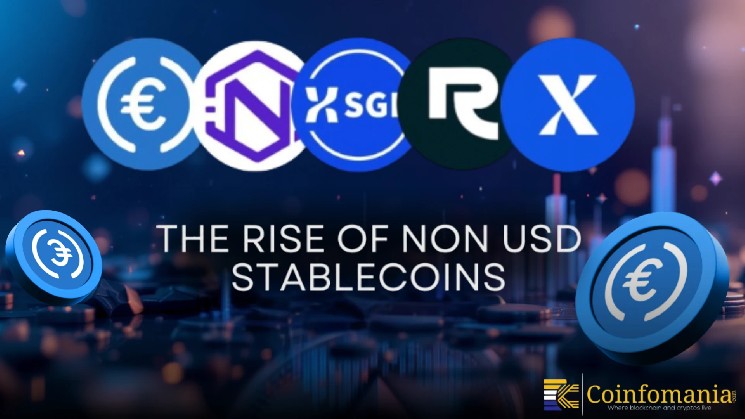
Non-USD stablecoins do not follow a uniform development path. Instead, their design is jointly determined by regional regulatory environments and local market needs. This divergence creates distinct operational models for assets like EURC, BRLA, and XSGD, each reflecting the legal and financial infrastructure of its home jurisdiction.
EURC: European regulatory alignment
EURC operates within the European Union’s stringent legal framework. Its development is heavily influenced by the Markets in Crypto-Assets (MiCA) regulation, which mandates strict reserve transparency and issuer licensing. This regulatory pressure drives EURC toward a model of high compliance and institutional integration, prioritizing legal certainty over rapid expansion. The asset’s structure is designed to meet the expectations of European financial authorities, ensuring that on-chain EUR remains a compliant alternative to traditional banking rails.
BRLA: Brazilian financial inclusion
In Brazil, BRLA addresses the need for efficient cross-border settlements and financial inclusion. The Brazilian regulatory environment encourages innovation in payment systems, allowing BRLA to integrate with local banking infrastructure for seamless fiat on-ramps. Unlike the compliance-heavy EU model, BRLA’s trajectory focuses on utility and accessibility, leveraging Brazil’s high mobile penetration to serve unbanked populations. This approach results in a product designed for high-volume, low-value transactions rather than institutional custody.
XSGD: Singapore’s trusted anchor
XSGD is issued by a regulated entity in Singapore, a jurisdiction known for its clear and progressive digital asset guidelines. The Monetary Authority of Singapore (MAS) provides a stable regulatory backdrop that allows XSGD to function as a trusted digital anchor in Southeast Asia. Its development path emphasizes reserve backing by Singapore dollar bank deposits and cash, ensuring full convertibility. This model appeals to regional businesses seeking a stable, regulated digital currency for trade settlements, distinct from the more speculative nature of other crypto assets.
Comparative analysis
The following table contrasts the primary jurisdictions, backing assets, and regulatory drivers of these three stablecoins.
| Stablecoin | Primary Jurisdiction | Backing Asset | Key Regulatory Driver |
|---|---|---|---|
| EURC | European Union | Euro deposits | MiCA compliance |
| BRLA | Brazil | Brazilian Real | Payment system innovation |
| XSGD | Singapore | SGD bank deposits | MAS licensing |
On-chain forex infrastructure evolution
The architecture of decentralized foreign exchange is shifting from speculative trading venues to functional settlement layers. Non-USD stablecoins are no longer merely alternative stores of value; they are becoming the primary rails for cross-border liquidity in regions with volatile fiat currencies. This evolution addresses a specific friction point in the traditional banking system: the reliance on correspondent banking networks for currency pairs that lack deep institutional interest.
Traditional SWIFT transfers for non-major currency pairs often require multiple intermediary banks, each adding fees and processing delays. In contrast, on-chain infrastructure allows for direct peer-to-peer settlement of EUR, GBP, or JPY-denominated assets. This reduces the number of touchpoints in a transaction, thereby lowering costs and increasing transparency. The efficiency gain is particularly pronounced for emerging market corridors where traditional banking access is limited or expensive.
Regional regulatory environments are now jointly determining the trajectory of this infrastructure. Unlike the USD, which benefits from a unified global framework, non-USD stablecoins must navigate distinct legal landscapes in the Eurozone, United Kingdom, and Japan. This has led to a fragmented but increasingly robust ecosystem where compliance is baked into the protocol layer rather than applied retroactively.
The result is a decentralized forex market that operates alongside, rather than in opposition to, traditional finance. By providing a transparent, programmable layer for currency exchange, these stablecoins enable businesses and individuals to hedge against local currency fluctuations without relying on complex derivative products. This infrastructure is not replacing the dollar, but it is establishing a durable, alternative channel for global commerce that prioritizes accessibility and speed.
Regulatory hurdles for regional issuers
Non-USD stablecoins operate in a fragmented legal landscape where compliance is not merely a formality but a barrier to entry. While US dollar-denominated tokens benefit from global liquidity, regional issuers face stringent licensing requirements that vary drastically by jurisdiction. The European Union’s Markets in Crypto-Assets (MiCA) regulation and the United Kingdom’s Financial Conduct Authority (FCA) guidance represent the most rigorous frameworks, demanding rigorous reserve audits and strict capital adequacy ratios.
For issuers targeting the Eurozone or the UK, the cost of compliance is substantial. Regular attestation of reserves by independent auditors is mandatory, and any deviation from the peg can trigger immediate regulatory scrutiny. In stricter jurisdictions, failure to meet these standards often results in delisting from major exchanges, effectively cutting off the token from its primary market. This high-stakes environment means that only well-capitalized issuers with robust legal teams can sustain operations.
The dominance of USD stablecoins is partly a result of these hurdles. As noted in industry analysis, non-USD stablecoins remain niche because the regulatory playbook for building a compliant regional token is significantly more complex than for its US counterpart. Issuers must navigate local central bank requirements, anti-money laundering (AML) protocols, and consumer protection laws simultaneously. This complexity limits scalability and keeps the market share of EUR, GBP, and JPY stablecoins marginal compared to the US dollar.
Investors and issuers must recognize that regulatory clarity is still evolving. While MiCA provides a unified framework in the EU, other regions lack equivalent clarity, creating legal uncertainty. This uncertainty increases the risk of sudden policy shifts that could render a stablecoin non-compliant overnight. Therefore, due diligence on the issuer’s regulatory standing is as critical as assessing the underlying reserve assets.
No comments yet. Be the first to share your thoughts!