Market share trends for non-USD assets
The global stablecoin market remains overwhelmingly anchored by the US dollar. Despite significant regulatory advancements in Europe and Asia, non-USD stablecoins currently hold less than 1% of the total market capitalization. This dominance is structural; the US dollar serves as the primary reserve currency for cross-border settlements, making USD-pegged assets the default choice for liquidity providers and institutional traders.
However, recent data indicates a distinct shift in the non-USD segment. Circulating supply for non-USD stablecoins has reached approximately $2 billion, driven by a $600 million influx since the start of the year. This growth is not uniform. It is concentrated in specific jurisdictions where local currencies face volatility or where regulatory frameworks like the EU’s MiCA have provided clear pathways for issuance. Euro-backed and Singapore dollar-backed tokens are seeing increased adoption among retail and SME users seeking to hedge against local fiat depreciation.
The disparity between USD and non-USD assets is stark. While non-USD supply has grown, it struggles to crack 0.5% of the total market share in many high-volume trading pairs. This suggests that while local demand is real, it has not yet translated into broad-based market dominance. The growth is incremental rather than exponential, reflecting a cautious adoption curve where users prefer the liquidity and network effects of established USD stablecoins.
Regulatory frameworks driving adoption
Regulation is no longer a barrier for non-USD stablecoins; it is the primary engine of their legitimacy. As local financial authorities in Europe and Latin America enforce stricter compliance standards, issuers are forced to align with established legal frameworks. This shift separates regulated entities from unregulated offshore operators, creating a safer environment for institutional and retail adoption.
In Europe, the Markets in Crypto-Assets (MiCA) regulation has set a clear precedent. Under MiCA, issuers of euro-backed stablecoins like Circle’s EURC and Tether’s EURT must maintain strict reserve requirements and transparency. This regulatory clarity has driven significant growth in the euro stablecoin market, which now accounts for approximately 80% of all non-USD stablecoin supply.
Similarly, in Latin America, local payment laws and digital asset regulations are encouraging the on-chain adoption of local currencies. Countries like Brazil and Argentina are seeing a surge in stablecoin usage as citizens seek to hedge against local currency volatility. This demand is supported by local regulators who are developing frameworks that allow for the issuance of stablecoins backed by local fiat reserves.
The result is a market where non-USD stablecoins are growing faster than their USD counterparts. Data indicates that non-USD stablecoin supply has grown threefold, outpacing USD stablecoins, which grew by 130% over the same period. This trend highlights how local regulatory frameworks are not just complying with global standards but are actively fostering the growth of local currency stablecoins.
Regional stablecoins and local use cases
While the US dollar dominates global crypto liquidity, non-USD stablecoins are capturing market share in regions with currency volatility or limited banking access. These assets serve as critical infrastructure for cross-border trade, remittances, and local settlement, offering an alternative to traditional correspondent banking networks.
Mexican Peso (MXN) and Brazilian Real (BRL)
In Latin America, MXN and BRL stablecoins facilitate rapid, low-cost transactions for unbanked populations and small businesses. These coins allow users to hold local currency value on-chain, protecting against inflation while enabling instant peer-to-peer transfers. The growth is driven by practical utility rather than speculation, with adoption concentrated in areas where traditional banking is slow or expensive.
Nigerian Naira (NGN)
Nigeria’s NGN stablecoins address the country’s foreign exchange shortages and high remittance fees. By pegging to the local currency, these tokens provide a stable store of value and a faster channel for receiving funds from abroad. This use case is particularly vital for a large youth population that relies on digital wallets for daily commerce.
Euro (EUR) Stablecoins
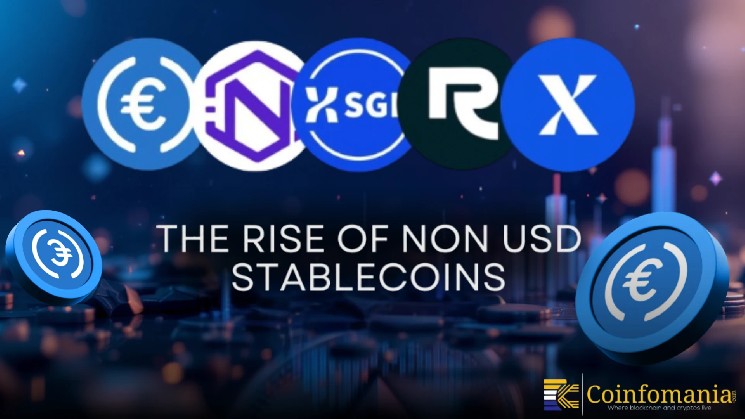
Euro-pegged stablecoins, such as EURC and EUROC, are increasingly used for settling invoices and holding reserves within the European Union. These assets offer transparency and programmability for businesses operating across borders, reducing the friction of traditional SWIFT transfers. Regulatory clarity under MiCA has further encouraged institutional adoption.
Comparison of Regional Stablecoins
The table below outlines key differences between major non-USD stablecoins, focusing on their backing, primary use cases, and regulatory status.
| Stablecoin | Issuer | Backing Asset | Primary Use Case | Typical Yield APY |
|---|---|---|---|---|
| USDT.e (MXN) | Tether | USD Reserves | Cross-border trade | 0-2% |
| USDC.e (BRL) | Circle | USD Reserves | Remittances | 0-1.5% |
| NGN Stablecoin | Various (e.g., Kuda, Paga) | NGN Bank Deposits | Local settlement | 0-5% |
| EURC | Circle | USD/EUR Reserves | EU Settlements | 0-3% |
Yield opportunities and risks
Non-USD stablecoins offer higher nominal yields than their USD counterparts, but this advantage is often offset by currency devaluation. The euro dominates the non-USD market, holding approximately 80% of the supply, yet even major fiat-pegged tokens face inherent inflation risks that USD assets do not. When local currencies weaken, the real value of the yield can evaporate, turning a seemingly attractive return into a net loss.
The mechanism for generating these yields typically involves lending the underlying fiat reserves or investing in local government bonds. While this provides a steady income stream, it introduces counterparty risk and regulatory complexity. Investors must weigh the higher percentage yield against the potential depreciation of the base currency. A 5% yield on a token pegged to a currency losing 3% in value is a net gain of only 2%, and that does not account for transaction fees or volatility spikes.
Market data shows that non-USD stablecoin supply has grown significantly, reaching an all-time high circulating supply of $2 billion. This growth suggests increasing demand for localized digital cash, particularly in regions with unstable banking systems. However, the yield differential is rarely enough to justify the additional risk for conservative investors. The primary appeal remains access and speed, not yield maximization.
Frequently asked questions about local stables
Are all stablecoins backed by USD?
No. While the vast majority are, non-USD stablecoins do exist. According to Wikipedia, 95% of stablecoins are fiat-backed, and of those, 97% are denominated in US dollars. The remaining fraction includes assets pegged to the Euro (EUR), Yen (JPY), and other local currencies, though they hold significantly smaller market shares.
Why hold stablecoins instead of USD?
Holding stablecoins offers operational advantages over traditional bank deposits, particularly in cross-border contexts. The Bank of England notes that stablecoins allow holders to exchange coins for fiat money "easily and without losing anything." This liquidity is critical for settlement, as Reddit discussions highlight that stablecoins are primarily used for settlement rather than everyday payments.
Can I convert non-USD stablecoins to local fiat?
Conversion depends on the specific asset and regional regulations. Major platforms like Kraken list popular stablecoins such as USDC and Tether, but availability of local currency pairs (e.g., EUR/DAI) varies by jurisdiction. Always verify the issuer’s redemption policy and the exchange’s supported withdrawal methods before holding non-USD stablecoins.
No comments yet. Be the first to share your thoughts!