
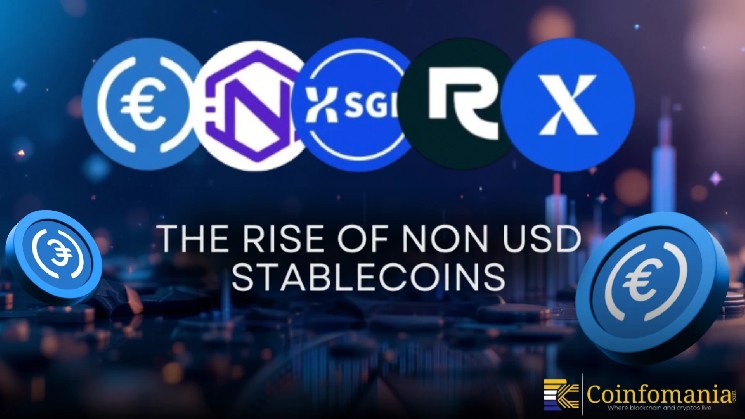
The rise of non-USD stablecoins
The stablecoin market is overwhelmingly dominated by the US dollar, which accounts for more than 99.3% of the total market capitalization. Despite this near-total hegemony, a small but growing segment of non-USD stablecoins is beginning to emerge. This niche includes fiat-pegged tokens such as EURT (Euro), GBP stablecoins, and MXN (Mexican Peso) variants, which aim to serve specific regional payment needs rather than global speculation.
Recent data indicates that this segment is expanding, albeit from a tiny base. A report by Visa and Dune Analytics noted that the non-USD stablecoin market reached approximately $1.1 billion in February, having tripled in value over just three years. While this growth is significant in percentage terms, the absolute market size remains negligible compared to the trillions held in USD-pegged assets like USDT and USDC.
The limited scale reflects the structural challenges facing non-USD stablecoins. Liquidity is fragmented across multiple fiat currencies, and regulatory clarity varies significantly by jurisdiction. For now, these assets serve as experimental infrastructure for cross-border trade in specific corridors, rather than a serious challenger to dollar dominance. The trajectory suggests cautious adoption, driven by regional demand rather than broad market shifts.
Note: The chart above shows the dominant USD stablecoin (USDT) for context. Non-USD stablecoins lack the liquidity and volume to support comparable standalone technical charts at this stage.
Comparing major non-USD stablecoin options
The non-USD stablecoin market has fragmented into distinct regional blocs, each serving specific liquidity needs. While USDT and USDC dominate global volume, non-USD alternatives provide essential infrastructure for local economies and cross-border trade in Europe, Latin America, and Asia. This section compares four primary options: EURT, GBP-backed coins, MXN tokens, and BRL tokens.
The following table outlines the structural differences between these assets, focusing on issuer, backing mechanism, and primary utility. These distinctions determine regulatory risk and operational suitability for institutional and retail users.
European Market: EURT
Tether’s EURT remains the largest euro-pegged stablecoin by market capitalization. It is fully backed by cash and cash equivalents held in regulated European banks. Its primary utility lies in facilitating trading pairs within European decentralized finance (DeFi) protocols and enabling cross-border remittances where the euro is the settlement currency. Regulatory scrutiny under MiCA (Markets in Crypto-Assets Regulation) requires strict transparency regarding its reserve composition and redemption mechanisms.
United Kingdom: GBP-Backed Options
The UK market lacks a single dominant stablecoin, with several issuers offering GBP-pegged assets. These tokens are typically backed by a combination of cash and short-term UK government bonds (gilts). Their use case is heavily tied to the UK’s traditional financial infrastructure, particularly for settling fiat payments and providing liquidity in UK-centric DeFi pools. Regulatory compliance is stringent, requiring adherence to the UK’s Financial Conduct Authority (FCA) guidelines on cryptoasset stability.
Latin America: MXN and BRL Stablecoins
MXN and BRL stablecoins serve as critical bridges for local economies with high inflation or limited access to traditional banking. MXN tokens are often used for trade finance between the US and Mexico, while BRL tokens facilitate retail payments and DeFi participation in Brazil. These assets are usually backed by local bank deposits, requiring issuers to navigate complex local banking regulations. Their growth is driven by the need for dollar-adjacent stability without direct USD exposure, offering a hedge against local currency volatility while maintaining regional liquidity.
Key Considerations for Selection
When evaluating non-USD stablecoins, prioritize issuers with audited reserves and clear regulatory licensing. EURT benefits from established liquidity and Tether’s infrastructure, but carries counterparty risk associated with its reserve management. GBP stablecoins offer regulatory clarity in the UK but face fragmentation. MXN and BRL tokens provide essential local utility but require careful due diligence on local banking partnerships and reserve transparency. Always verify the specific reserve composition and redemption rights before integrating these assets into financial workflows.
Regulatory hurdles across jurisdictions
The regulatory landscape for non-USD stablecoins is defined by a sharp divide between mature markets with clear frameworks and emerging economies navigating complex compliance hurdles. While the European Union has established a comprehensive rulebook, other major jurisdictions are still solidifying their positions, creating a fragmented environment for issuers of EUR, GBP, and MXN pegged assets.
The EU’s MiCA framework
The Markets in Crypto-Assets (MiCA) regulation has become the global benchmark for stablecoin oversight. Under MiCA, Electronic Money Tokens (EMTs) like EURT must maintain full 1:1 backing with high-quality liquid assets held in segregated reserves. Issuers face strict capital requirements and must obtain authorization from national competent authorities, such as BaFin in Germany or the ACPR in France.
This regulatory clarity has boosted institutional confidence in EU-pegged assets, but it has also raised the barrier to entry. Smaller issuers without significant legal infrastructure struggle to meet the rigorous reporting and reserve auditing standards mandated by the regulation.
The UK’s evolving stance
Post-Brexit, the UK is positioning itself as a competitive alternative to the EU, though its regulatory path remains less defined for non-bank stablecoin issuers. The UK government’s stablecoin legislation aims to bring stablecoin activities under the purview of the Financial Conduct Authority (FCA) and the Bank of England. However, unlike MiCA’s broad crypto-asset scope, the UK approach is narrower, focusing primarily on payments and settlement functions.
This selective approach creates uncertainty for issuers of GBP-pegged tokens who wish to offer broader financial services. The lack of a comprehensive "crypto passport" equivalent to MiCA means that UK-authorized stablecoins do not automatically gain access to the larger EU market, limiting their scalability compared to EU-compliant peers.
Emerging markets and liquidity risks
In emerging economies, the regulatory environment for non-USD stablecoins is often reactive rather than proactive. Countries in Latin America and Asia are increasingly recognizing the utility of local currency stablecoins for remittances and inflation hedging, but legal clarity is scarce.
The primary challenge here is not just regulatory compliance, but structural liquidity fragmentation. As noted by industry analysts, non-USD stablecoins face inherent difficulties in achieving the deep, unified liquidity pools that characterize the US dollar market. Without clear regulatory harmonization across borders, issuers of assets like MXN or BRL pegs must navigate a patchwork of national laws, increasing operational costs and legal risk.
| Jurisdiction | Regulatory Status | Key Requirement |
|---|---|---|
| European Union | Fully Implemented (MiCA) | Full 1:1 reserve backing; national authorization |
| United Kingdom | In Progress | FCA/BoE oversight; narrow payment focus |
| Emerging Markets | Fragmented | Varies by country; often restrictive or unclear |
Liquidity fragmentation and real-world settlement
Non-USD stablecoins face a structural disadvantage: liquidity is fragmented across dozens of currencies, whereas the USD-dominated ecosystem benefits from deep, unified pools. This fragmentation creates wider bid-ask spreads and higher slippage, particularly for lower-volume pairs like EURT or GBP-backed tokens. While USD stablecoins trade with near-zero friction on major exchanges, non-USD variants often struggle to maintain consistent depth, making them less suitable for high-frequency trading or large-scale arbitrage.
Despite these liquidity headwinds, non-USD stablecoins offer genuine utility in specific, localized contexts. They are most effective for cross-border remittances within currency blocs, such as sending EUR between European countries or MXN between Mexico and the United States. In these scenarios, the value proposition lies in avoiding foreign exchange fees and traditional banking delays, rather than speculative trading. For instance, a business in Germany settling with a partner in France may prefer EURT over USD intermediaries to eliminate conversion costs entirely.
However, for global trade settlement, USD remains the undisputed standard. Most international invoices, commodity pricing, and interbank transfers are denominated in dollars. Non-USD stablecoins lag in this space because they cannot easily replace the network effects already built around USD. Attempting to use a local currency stablecoin for global commerce often introduces more complexity than it solves, requiring multiple conversions back to USD for final settlement. Consequently, these assets serve best as regional bridges rather than global replacements.
No comments yet. Be the first to share your thoughts!